
Cashew De-Oiled Cake vs Biomass Briquettes: Pros & Cons
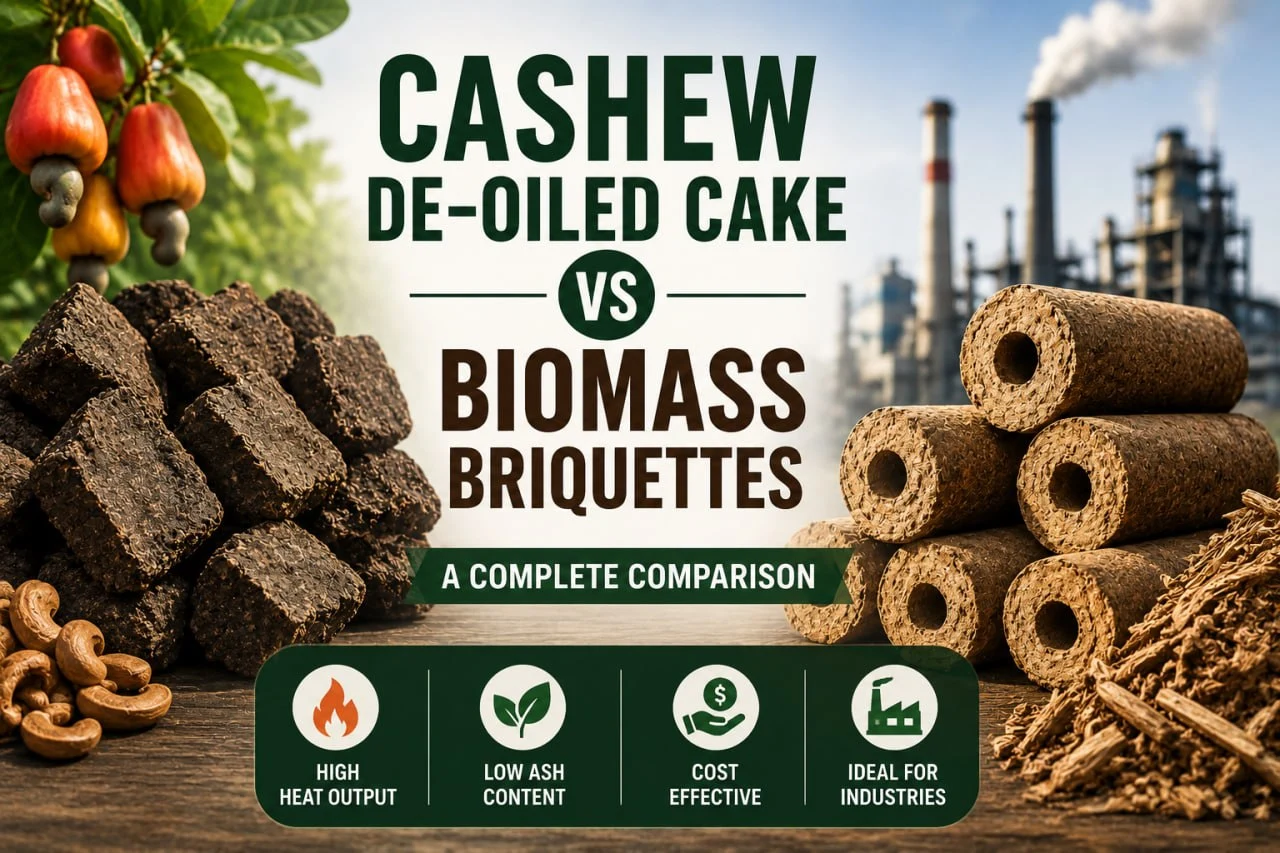
For decades, coal has been the primary source of industrial heat. However, rising fuel prices, stricter environmental regulations, and the growing need for sustainable manufacturing have encouraged industries to shift towards renewable biomass fuels. Among the most reliable alternatives, Cashew De-Oiled Cake and Biomass Briquettes have gained significant popularity because they offer consistent heat generation while reducing dependence on fossil fuels.
Although both fuels belong to the biomass category, their performance inside industrial boilers is quite different. The raw material, calorific value, ash generation, combustion quality, and long-term operating cost all influence which option is better for a particular industry. Choosing the right fuel is not only about purchasing price it directly impacts steam production, boiler efficiency, maintenance, and overall profitability.
This comprehensive guide explains the complete comparison between Cashew De-Oiled Cake vs Biomass Briquettes so manufacturers can make an informed decision based on performance rather than assumptions.
Understanding Cashew De-Oiled Cake
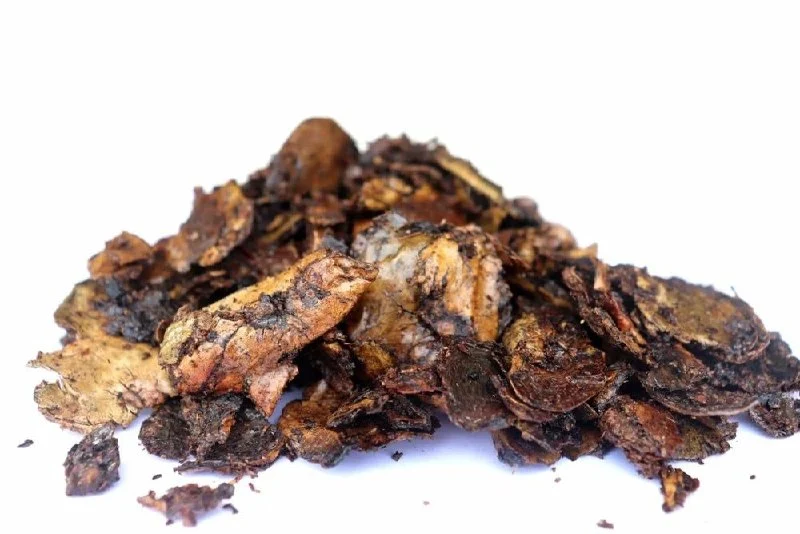
Cashew De-Oiled Cake, often called Cashew DOC, is produced after extracting valuable oil from cashew shells. Instead of becoming industrial waste, the remaining solid residue is processed into a high-energy biomass fuel. Its dense structure, low moisture content, and excellent calorific value make it one of the most efficient fuels for industrial steam boilers and thermal heating systems.
Industries such as textile manufacturing, food processing, paper mills, ceramics, and chemical plants prefer Cashew De-Oiled Cake because it burns consistently and produces stable heat with comparatively lower ash. Since the fuel originates from agricultural processing waste, it also supports circular economy practices by converting residue into renewable energy.
What are Biomass Briquettes?
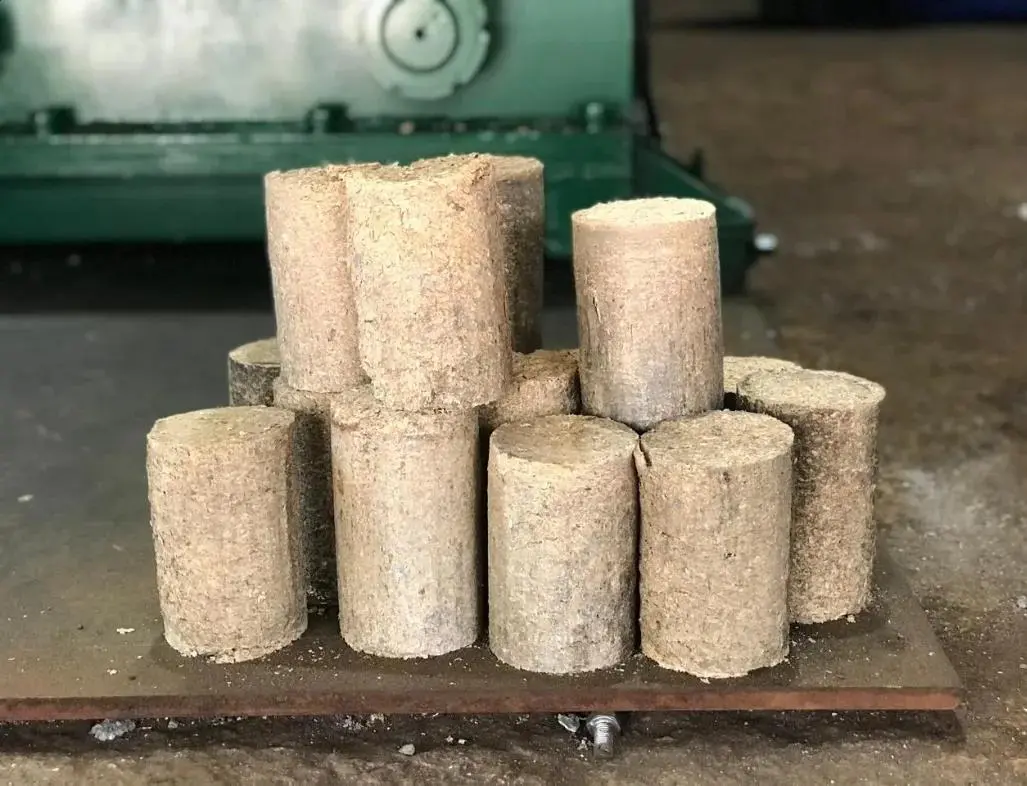
Biomass Briquettes are compressed solid blocks manufactured from agricultural and forestry residues including sawdust, rice husk, bagasse, groundnut shells, cotton stalk, and other crop waste. During production, these materials are compressed under high pressure without chemical binders, creating a dense renewable fuel suitable for industrial combustion.
The biggest advantage of Biomass Briquettes is their availability. Since different agricultural wastes can be used as raw material, briquettes are manufactured across many regions and are widely adopted by brick kilns, rice mills, dairy industries, and medium-scale manufacturing units. Their performance, however, depends greatly on the quality of raw material used during production.
Why This Comparison Matters
Many industries compare biomass fuels only on the basis of price per ton. In reality, the actual operating expense depends on how much heat the fuel produces, how much ash it generates, and how efficiently it burns inside the boiler. A cheaper fuel that requires higher consumption may eventually become more expensive than a premium-quality biomass fuel.
That is why comparing Cashew De-Oiled Cake vs Biomass Briquettes requires evaluating calorific value, combustion efficiency, moisture content, maintenance cost, emissions, and long-term industrial performance together rather than individually
Calorific Value: The Most Important Performance
Indicator
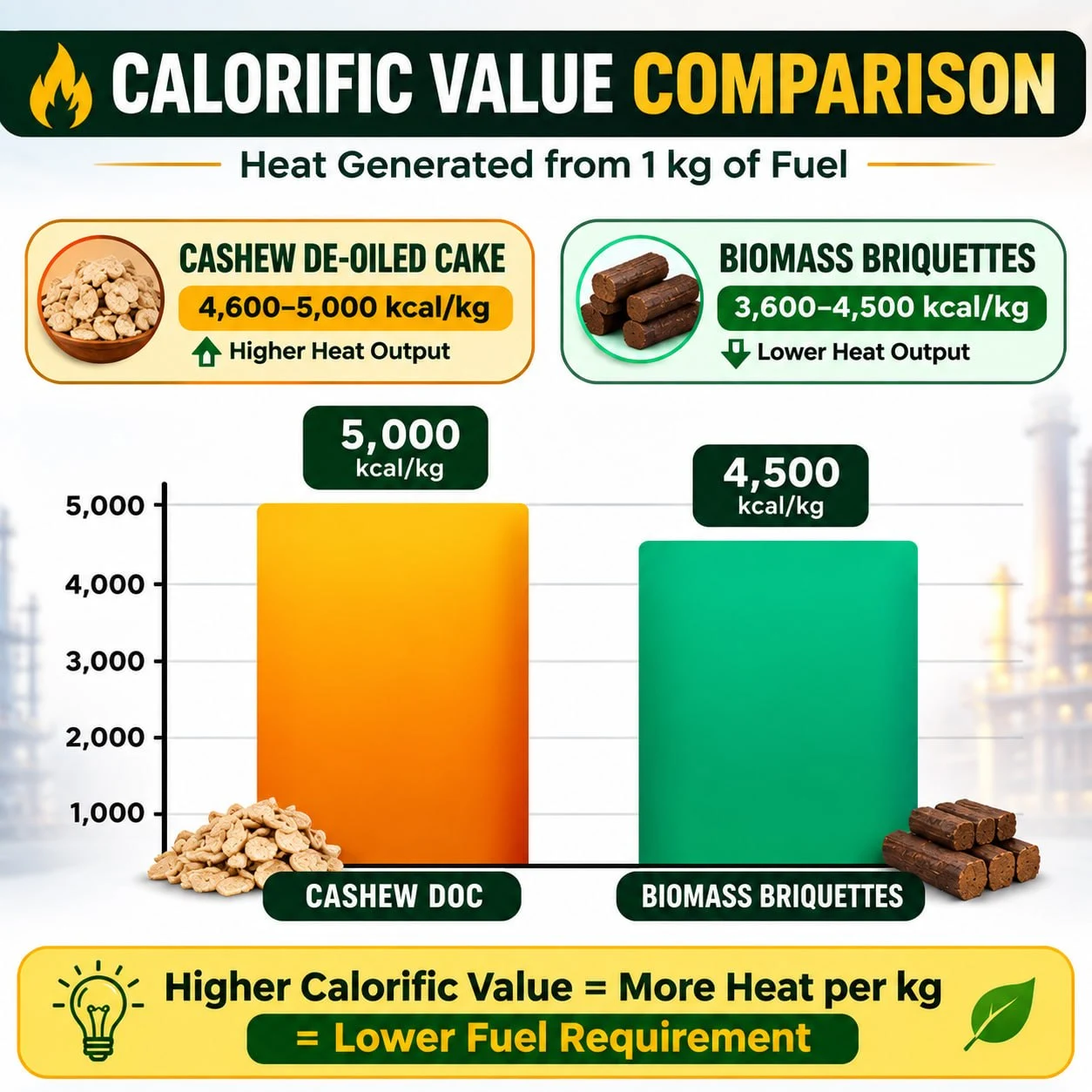
When selecting any industrial biomass fuel, calorific value becomes the first and most critical factor. It represents the amount of heat generated from one kilogram of fuel. The higher the calorific value, the lower the fuel required to produce the same quantity of steam.
Cashew De-Oiled Cake generally delivers between 4,600 and 5,000 kcal/kg, making it one of the highest-performing biomass fuels available in the industrial market. Its dense composition ensures powerful and stable combustion, allowing boilers to achieve higher thermal efficiency with lower fuel consumption.
Biomass Briquettes usually provide 3,600 to 4,500 kcal/kg, although the exact figure varies depending on whether they are manufactured from sawdust, rice husk, or bagasse. Premium wood-based briquettes perform better than crop-residue briquettes, but they still remain slightly behind Cashew DOC in overall heat output.
For industries where uninterrupted steam production is essential, the higher energy density of Cashew De-Oiled Cake often results in noticeable savings in daily fuel usage.
Moisture Content and Combustion Efficiency
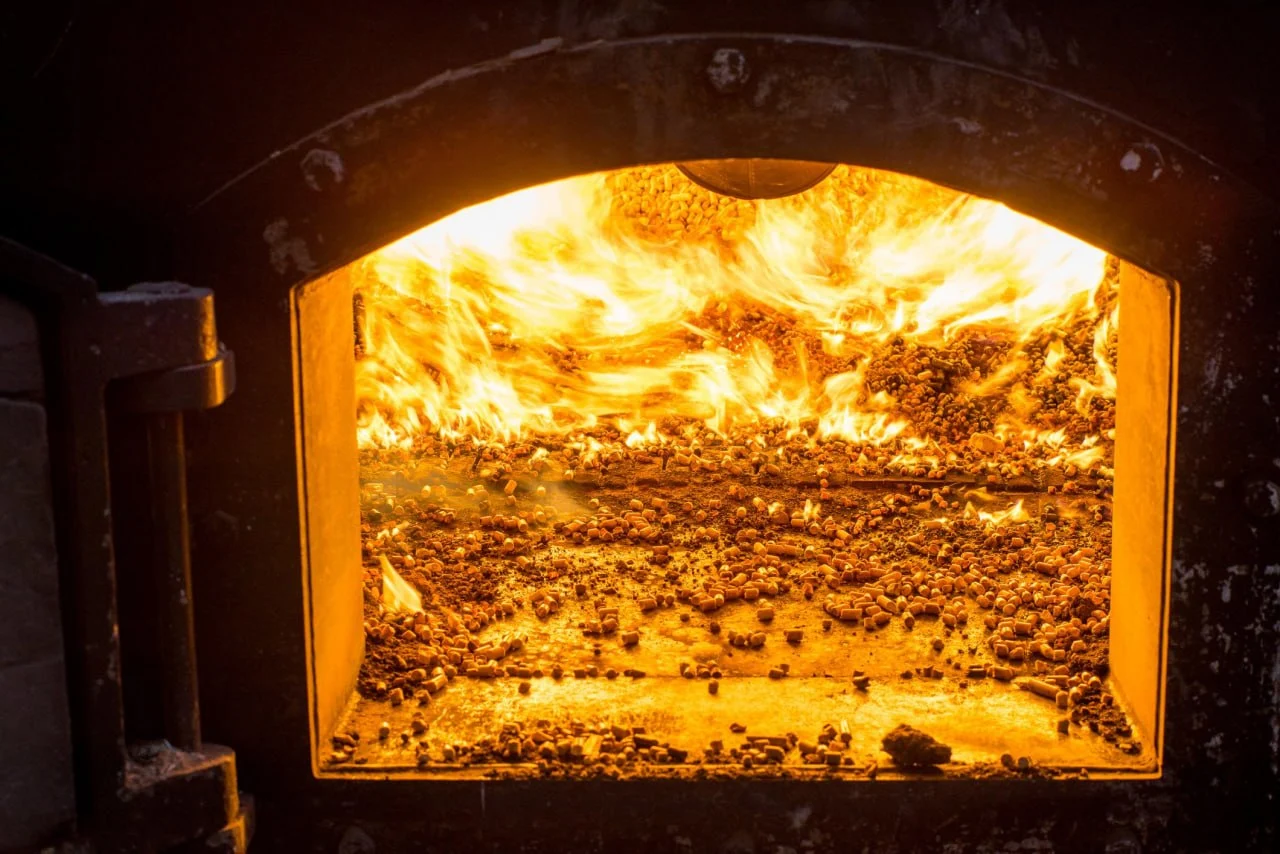
Moisture may seem like a small factor, but it significantly influences combustion quality. Before producing useful heat, a boiler must first evaporate the water present in the fuel. The more moisture the fuel contains, the more energy gets wasted during combustion.
Cashew De-Oiled Cake naturally contains low moisture, allowing it to ignite quickly and maintain a steady flame. Operators often observe faster steam generation and more consistent furnace temperature because very little heat is lost in drying the fuel during burning.
In comparison, Biomass Briquettes are more susceptible to absorbing atmospheric moisture during storage. If stored improperly in humid conditions, their combustion quality can decrease, leading to slower ignition and slightly reduced boiler efficiency. Proper warehouse ventilation and pallet storage become important to maintain their performance.
For industries running boilers continuously across multiple shifts, lower moisture directly contributes to improved thermal efficiency and reduced operational loss.
Ash Content and Boiler Maintenance
Every kilogram of ash generated inside a boiler eventually becomes a maintenance cost. Excessive ash reduces heat transfer efficiency, increases clinker formation, and requires frequent shutdowns for cleaning.
One of the strongest advantages of Cashew De-Oiled Cake is its comparatively low ash generation. Cleaner combustion means fewer deposits on boiler tubes, improved heat exchange, and longer operating intervals before maintenance becomes necessary. Lower ash also reduces disposal costs for factories handling large volumes of fuel every day.
Biomass Briquettes perform differently depending on their raw material. Briquettes made from rice husk generally create more ash, while sawdust briquettes produce relatively less. Because of this variation, industries often experience inconsistent maintenance requirements unless fuel quality remains standardized.
From an operational perspective, lower ash translates into higher productivity because boilers spend more time generating steam and less time undergoing cleaning.
Environmental Impact and Sustainability
Sustainability has become a major purchasing criterion for modern industries. Governments, export buyers, and environmentally conscious manufacturers increasingly prefer fuels that reduce carbon emissions without compromising production efficiency.
Both Cashew De-Oiled Cake and Biomass Briquettes qualify as renewable boiler fuels because they utilize agricultural waste materials instead of fossil resources. Rather than burning or discarding agricultural residue, these fuels convert waste into valuable industrial energy.
Cashew De-Oiled Cake contributes to waste utilization within the cashew processing industry, while Biomass Briquettes help recycle crop residues that might otherwise be openly burned in agricultural fields. Both alternatives significantly reduce dependence on coal and support cleaner industrial heating systems.
Although neither fuel is completely emission-free, both offer a considerably lower environmental footprint than conventional fossil fuels.
Cost: Looking Beyond Price Per Ton
One of the most common misconceptions in industrial purchasing is assuming that the lowest-priced fuel is automatically the most economical. In reality, industries should calculate cost per unit of usable heat, not simply cost per ton.
Biomass Briquettes often have a lower market price, making them attractive for businesses with limited procurement budgets. However, because their calorific value is generally lower, boilers may require greater fuel consumption to achieve identical steam output.
Cashew De-Oiled Cake, despite sometimes carrying a slightly higher purchase price, often compensates through better combustion efficiency, lower daily consumption, reduced ash disposal, and fewer maintenance shutdowns. When total operating expenses are considered, many medium and large manufacturing units find DOC to be the more profitable long-term investment.
The smarter financial question is therefore not “Which fuel is cheaper?” but “Which fuel generates more heat with lower overall operational cost?”
Storage and Handling Performance
Cashew De Oiled Cake: Store in a dry, ventilated warehouse to preserve its naturally low moisture content and combustion quality.
Biomass Briquettes: Keep stacked on pallets and protected from humidity to reduce moisture absorption during storage.
Storage quality directly affects fuel performance. Even high-quality biomass can lose efficiency if exposed to rain or excessive humidity. Cashew De-Oiled Cake maintains its combustion properties well when stored in dry warehouses, while Biomass Briquettes require additional protection against moisture absorption.
Using elevated pallets, proper ventilation, and first-in-first-out inventory rotation helps preserve the quality of both fuels. Good storage practices not only improve combustion but also reduce material wastage during transportation and handling.
Which Industries Benefit the Most?
Different manufacturing sectors have different heating requirements, so fuel selection should match the production process rather than market trends alone.
Cashew De-Oiled Cake is especially suitable for textile factories, food processing units, chemical industries, ceramic manufacturers, paper mills, and high-capacity steam boiler operations where consistent heat and lower ash are essential.
Biomass Briquettes are widely used in brick kilns, dairy plants, rice mills, commercial heating systems, and small to medium manufacturing units where affordability and regional availability are stronger priorities.
For operations requiring continuous, high-temperature steam, Cashew De-Oiled Cake generally offers better reliability and thermal stability.
Pros and Cons at a Glance
Cashew De-Oiled Cake
Advantages: Higher calorific value, lower moisture, cleaner combustion, reduced ash, better boiler efficiency, and lower maintenance frequency.
Limitations: Slightly higher procurement price and availability concentrated around cashew-producing regions.
Biomass Briquettes
Advantages: Affordable purchase cost, wide availability, renewable raw materials, and easy transportation.
Limitations: Variable calorific value, higher ash in some varieties, moisture sensitivity, and less consistent combustion depending on raw material quality.
Final Verdict: Which Biomass Fuel is Better?
There is no universal fuel for every industry, but there is a clear performance difference. If your objective is maximum heat output, lower fuel consumption, improved boiler efficiency, and reduced maintenance, Cashew De-Oiled Cake is the stronger choice. Its higher calorific value and cleaner combustion make it particularly valuable for industries operating large steam boilers where thermal efficiency directly affects profitability.
On the other hand, Biomass Briquettes remain an excellent renewable alternative for businesses seeking a cost-effective and widely available industrial fuel. They perform well in many heating applications, especially when high-quality wood-based briquettes are used.
Ultimately, the decision should be based on total operating efficiency rather than purchase price alone. For manufacturers looking to replace coal with a high calorific biomass fuel, Cashew De-Oiled Cake offers one of the most balanced combinations of performance, sustainability, and long-term value.
