
The Future of Cashew De-Oiled Cake in Global Markets
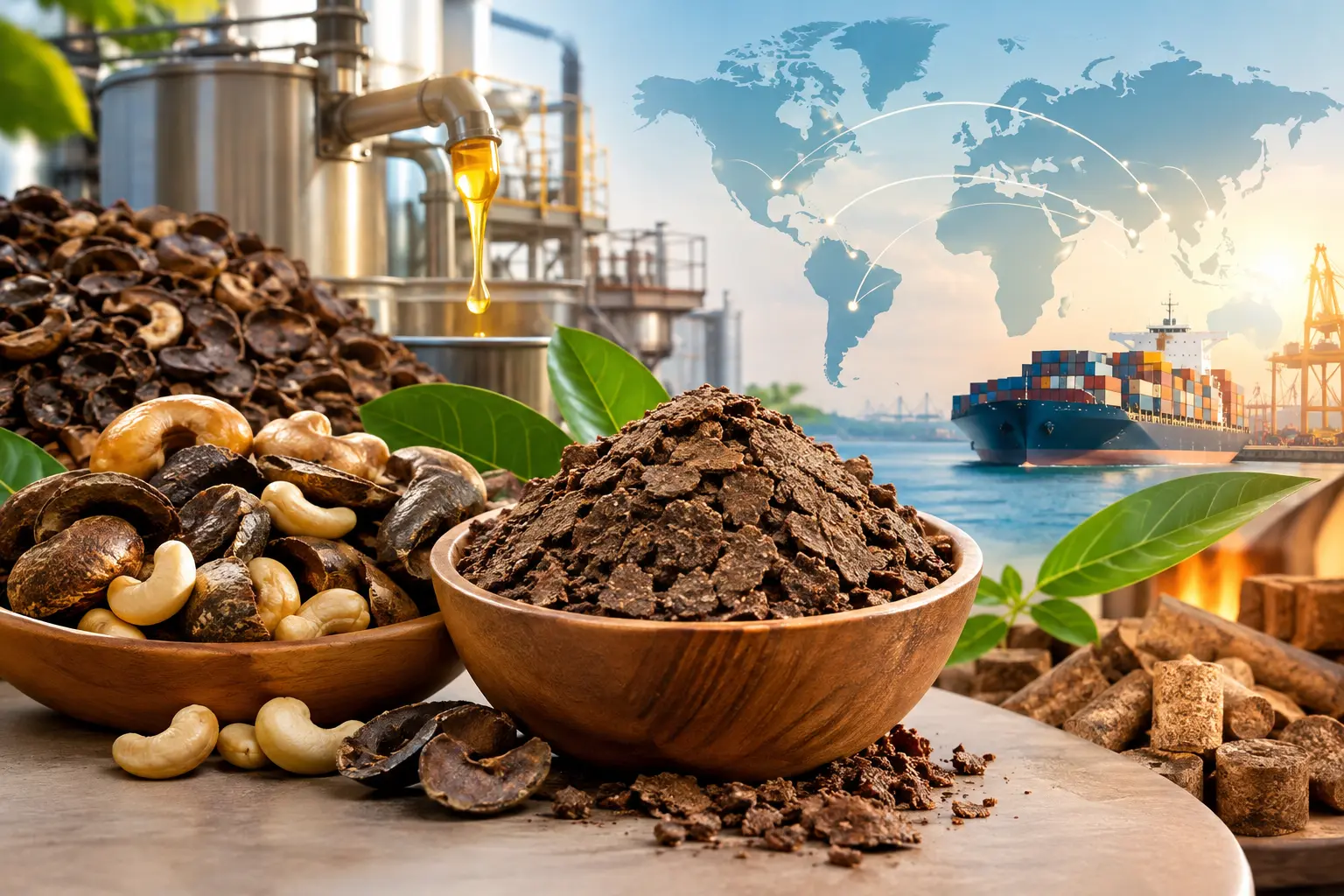
Cashew processing has traditionally been associated with the production of kernels, but the industry is increasingly looking beyond the edible nut. As manufacturers and processors focus on waste valorization, biomass utilization, circular production and sustainable raw materials, cashew processing by-products are gaining greater commercial importance.
One such by-product is Cashew De-Oiled Cake, also commonly referred to as de-oiled cashew cake when it is produced after the extraction of Cashew Nut Shell Liquid (CNSL). What was once considered mainly a residue from cashew processing is gradually becoming a useful industrial material, particularly in applications involving biomass fuel, industrial heating and resource recovery.
The future of this material will depend on how effectively processors, manufacturers, exporters and industrial buyers can convert a low-value residue into a consistent and commercially useful product.
What Is Cashew De-Oiled Cake?
Cashew De-Oiled Cake is the solid residue that remains after oil, particularly Cashew Nut Shell Liquid (CNSL), has been extracted from cashew shells.
Cashew shells naturally contain CNSL, a valuable bio-based liquid used in several industrial applications. After extraction, the remaining shell material is known as de-oiled shell cake. Depending on the processing method and quality specifications, its moisture, residual oil, ash and calorific value can vary.
This distinction is important because cashew de-oiled cake should not automatically be treated as the same material as every other cashew processing residue.
Research and industry reports have identified de-oiled shell cake as a potential biomass fuel, while other cashew by-products can have completely different applications.
Why Is Cashew De-Oiled Cake Becoming More Important?
The global industrial sector is under increasing pressure to use resources more efficiently. Companies are looking for ways to reduce waste, lower dependence on conventional fossil fuels and create additional value from agricultural residues.
This is where cashew processing waste can become commercially interesting.
Instead of viewing the shell as something that simply needs to be disposed of, processors can extract CNSL and then find productive applications for the remaining cake.
This creates a more circular approach:
Cashew processing → CNSL extraction → De-oiled cake → Industrial utilization
Such an approach can provide additional revenue opportunities while reducing the amount of agricultural residue requiring disposal.
A study of cashew shell by-products found that de-oiled shell cake can be used as a biomass fuel and can serve as a substitute for wood in suitable industrial applications.
The Growing Role of Biomass Energy
One of the strongest opportunities for de-oiled cashew cake is industrial energy.
Industries that require continuous heat often consume large quantities of conventional fuels. Depending on local economics, regulations and equipment compatibility, biomass residues can provide an alternative or complementary fuel source.
De-oiled cashew cake has already been used in applications involving industrial boilers, furnaces, heating and curing processes. Commercial specifications reported by suppliers also show that the material can have a relatively high calorific value, although actual performance depends on quality, moisture and processing conditions.
This creates an important future opportunity.
As industries search for renewable industrial fuel, locally available agricultural residues could become increasingly valuable.
For cashew-producing countries, this can be particularly attractive because the raw material is generated close to processing facilities.
Global Industrial Markets Could Create New Demand
The future of cashew de-oiled cake exports will not depend only on production volume. It will depend on whether suppliers can meet the technical and logistical requirements of international buyers.
Industrial buyers generally need consistency.
They may look at:
Moisture content
Residual oil content
Ash content
Calorific value
Particle size
Bulk density
Packaging
Supply consistency
Loading and transportation costs
For international trade, these specifications can become just as important as the basic availability of the product.
A buyer may be interested in purchasing biomass material, but if moisture varies significantly from shipment to shipment or the calorific performance is inconsistent, the material becomes harder to use efficiently.
Therefore, the future market will increasingly favour suppliers capable of providing standardized Cashew De-Oiled Cake rather than simply selling an agricultural residue.
.webp?alt=media&token=7bcc38f6-cadf-49df-bc0c-0069a644363a)
From Waste Product to Industrial Commodity
One of the biggest changes could be the way the market itself views cashew de-oiled cake.
Historically, agricultural by-products were often treated as secondary materials. Today, the concept of by-product valorization is becoming much more important.
A residue becomes commercially valuable when there is:
1. A reliable source
2. A consistent quality
3. A clear application
4. A dependable buyer
5. Efficient transportation
6. Competitive economics
Cashew de-oiled cake already has several of these characteristics in markets where cashew processing and industrial biomass consumption are located close together.
The next step is building stronger supply chains between producers and industrial users.
Potential Applications Beyond Conventional Fuel
Fuel is currently one of the most established applications, but the future of cashew de-oiled cake utilization may not stop there.
Research into agricultural and oil-processing residues is increasingly examining applications such as soil improvement, bioenergy, biotechnology and other forms of resource recovery. However, these applications need to be evaluated carefully because the chemical composition and residual CNSL content can affect suitability.
For example, cashew shell residues contain compounds associated with CNSL, and processing methods can influence their safety and usability. Scientific reviews therefore emphasize appropriate processing and evaluation before using cashew by-products in applications such as animal feed.
This means future growth will likely come from application-specific processing, rather than assuming one grade of cake can be used everywhere.
The Opportunity for Industrial Boilers and Heat-Intensive Industries
Among the most practical opportunities is the replacement or supplementation of conventional biomass fuels in suitable industrial heating systems.
Industries such as:
Tile manufacturing
Cement-related operations
Industrial kilns
Food processing
Drying units
Manufacturing facilities
Other heat-intensive plants
may evaluate agricultural biomass based on its cost per unit of useful heat, availability and compatibility with their existing equipment.
Historical industry research has documented the use of de-oiled cashew shell cake as a biofuel for boilers and furnaces, including applications in tile factories, cement factories and kilns.
This makes industrial fuel one of the most realistic areas for future expansion.
Sustainability Could Become a Major Market Driver
Sustainability is no longer only a branding concept.
For many industrial businesses, reducing waste and improving resource efficiency is becoming part of operational planning.
Cashew shell waste utilization fits naturally into this model.
Instead of:
Shell → Waste → Disposal
the industry can move towards:
Shell → CNSL extraction → De-oiled cake → Industrial fuel/value-added application
This model increases the value extracted from the original raw material.
It also supports the broader concept of a circular economy, where agricultural materials are used more efficiently and fewer resources are wasted.
Studies on cashew processing residues have highlighted the economic and environmental potential of converting different cashew by-products into useful products rather than treating them simply as waste.
Technology Will Shape the Future
Technology will play an important role in determining how far the market can develop.
Better CNSL extraction can influence the quality of the remaining cake. Improved drying, storage and handling systems can help maintain consistency. Pelletisation or briquetting may also create opportunities where transportation, storage or automated feeding systems require a more uniform biomass fuel.
The global biomass market increasingly values materials that can be handled efficiently.
For Cashew De-Oiled Cake manufacturers, this means future competitiveness may depend not just on producing more material, but on improving:
Processing efficiency
Quality control
Moisture management
Storage
Packaging
Bulk handling
Export logistics
The product may gradually move from being traded simply as a residue to being sold as a defined industrial fuel or biomass commodity.
India and Other Cashew-Producing Regions
Countries with significant cashew-processing industries have an obvious advantage because the raw material is generated locally.
India, Vietnam, Brazil and several African countries have established roles in the wider cashew value chain. At the same time, African cashew-processing regions are increasingly exploring ways to capture more value from local processing rather than exporting raw agricultural materials.
This creates an opportunity for cashew shell processing companies, CNSL producers and biomass suppliers.
Instead of earning revenue from only the primary cashew product, processors can potentially develop multiple revenue streams:
Cashew kernels + CNSL + De-Oiled Cake + other by-products
That diversification could become increasingly important as processing costs and global competition continue to evolve.
What Will Global Buyers Expect in the Future?
The future buyer will likely be more technically demanding.
Bulk buyers may want detailed information about:
Product specifications
Origin
Processing method
Moisture
Calorific value
Residual oil
Ash
Packaging
Monthly supply capacity
Loading port
Documentation
Sustainability credentials
For exporters, this means having a professional B2B supply system will become increasingly important.
A strong supplier will not simply say that the product is “high quality.” It will provide measurable specifications and consistent shipment quality.
Challenges That the Industry Must Address
Despite its potential, the market is not without challenges.
Transportation can be a major factor because biomass products generally have a lower value-to-volume ratio than specialty chemicals. Shipping the material over very long distances may not always be economical.
Quality variation is another concern.
Different cashew processing methods can produce different shell residues. Moisture, residual oil and ash can influence the performance of the final product.
There is also the question of competition from other biomass fuels such as wood residues, rice husk, bagasse, palm kernel residues and biomass pellets.
Therefore, Cashew De-Oiled Cake suppliers will need to compete not simply on price, but on dependable quality, availability and delivered energy value.
The Road Ahead
The future of Cashew De-Oiled Cake in global industrial markets looks increasingly connected to three major trends: industrial decarbonization, circular economy practices and biomass utilization.
The product is unlikely to become valuable simply because it is a cashew by-product. Its real potential comes from its ability to serve a practical industrial purpose.
Where quality is consistent, transportation is economical and suitable industrial equipment is available, de-oiled cashew shell cake can become a useful biomass resource.
The next phase of the industry could therefore see more organized production, better quality standards, international sourcing networks and application-specific grades.
For cashew processors, this represents an opportunity to extract more value from every tonne of raw material. For industrial buyers, it creates another potential source of biomass energy. And for the wider cashew industry, it demonstrates how a processing residue can become part of a more sustainable and commercially efficient value chain.
Conclusion
Cashew De-Oiled Cake has the potential to move beyond its traditional identity as a processing residue.
Its future will depend on consistent quality, efficient logistics, technological improvements and the growth of industries looking for alternative biomass resources.
As global manufacturing moves towards more efficient resource utilization, materials that were previously considered waste are increasingly being reassessed for their commercial value.
Cashew de-oiled cake is one such material.
With the right processing, quality management and market development, it can become a meaningful part of the global industrial biomass market creating value not only from the cashew nut, but from the processing chain as a whole.
