
5 Things to Check Before Buying Cashew De Oiled Cake | Top Cashew
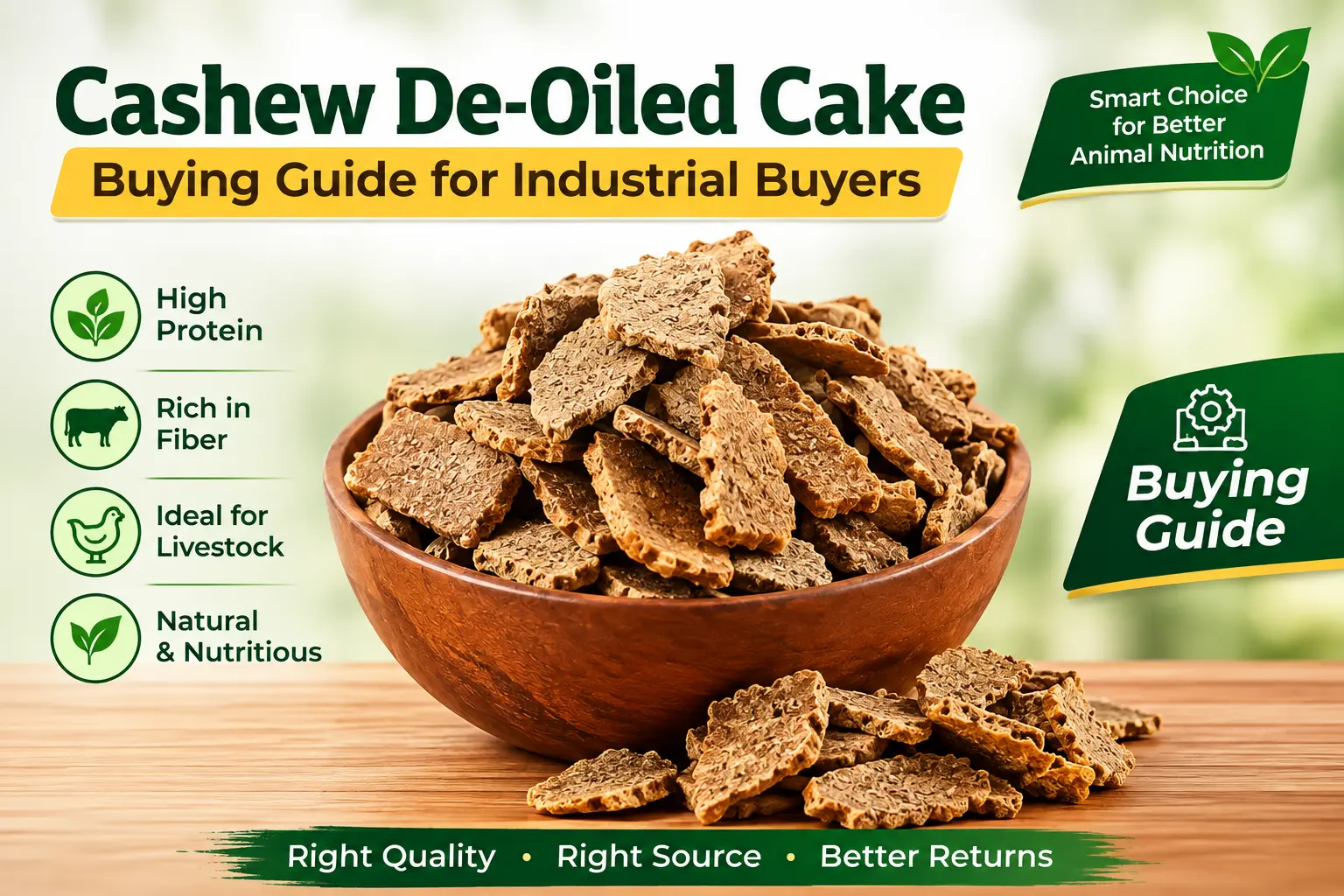
For industries that depend on boilers, furnaces, kilns, dryers, or other heating systems, choosing the right fuel is not simply about finding the lowest price per tonne.
Fuel quality directly affects heat generation, consumption, equipment performance, maintenance, and overall operating costs.
This is where Cashew De-Oiled Cake, commonly known as Cashew Shell Cake or Cashew De-Oiled Cake, has become an interesting biomass fuel option for industrial buyers.
Cashew De Oiled Cake is produced from cashew shells after the extraction of Cashew Nut Shell Liquid (CNSL). The remaining solid material can be used as a biomass fuel in suitable industrial heating applications. Industry sources commonly describe it as a fuel for boilers, furnaces, and other high-heat applications, with reported calorific values varying according to processing and product specifications.
But here's the important part: not every Cashew De Oiled Cake is necessarily the same.
Different suppliers can offer products with different moisture levels, ash content, calorific values, particle sizes, residual oil levels, and consistency.
So, if you're a manufacturer, procurement manager, boiler operator, or bulk biomass buyer, what should you actually check before placing an order?
Here are five important factors.
1. Check the Calorific Value
The first specification you should ask for is the calorific value. Calorific value indicates the amount of heat energy that can be released when the fuel is burned. For an industrial buyer, this number matters because it helps you understand the potential energy available from each kilogram of fuel.
Commercial specifications for Cashew De Oiled Cake can vary. For example, one supplier lists a gross calorific value of approximately 4,900 kcal/kg, while another commercial source reports a range around 4,800–5,000 kcal/kg. These figures should not be treated as a universal specification because actual values depend on processing and product quality.
Why does this matter?
Imagine you're comparing two suppliers.
Supplier A offers Cashew De Oiled Cake at a lower price per tonne, while Supplier B quotes a slightly higher price but provides a product with a stronger and more consistent energy specification.
The cheaper product may not necessarily provide the lowest cost per unit of useful heat.
That's why industrial buyers should ask:
What is the GCV?
Is the value supported by a laboratory report?
Is it tested regularly?
Is the specification consistent from batch to batch?
Is the quoted value based on the actual product being supplied?
Don't judge a biomass fuel only by its price.
Compare the price against its actual energy value and expected performance.
2. Check Moisture and Ash Content
After calorific value, moisture and ash content deserve serious attention.
Moisture is especially important because water in the fuel needs to be heated and evaporated during combustion. Excess moisture can reduce the amount of energy available for useful heating and may affect combustion efficiency.
Ash is the non-combustible residue left after burning. Excessive ash can increase cleaning requirements and may create operational issues depending on the type of boiler, furnace, or combustion system being used.
Commercial specifications for Cashew De Oiled cake can differ significantly between suppliers. For example, one listed product specifies moisture around 5–8% and ash around 5–8%, while other products may have different specifications.
That variation is exactly why buyers should ask for the actual specification sheet instead of assuming every cashew de oiled cake is the same.
Before purchasing, check:
Moisture Content: Lower and consistent moisture is generally desirable for combustion applications.
Ash Content: Understand how much residue the fuel is expected to produce.
Testing Method: Ask whether the figures are supported by laboratory analysis.
Batch Consistency: Make sure the specification is maintained from one shipment to another.
For a small trial order, these details might seem minor. For a factory consuming tonnes of biomass every month, they can have a significant impact on fuel handling and combustion performance.
3. Understand CNSL and the De-Oiling Process
If you're buying Cashew De-Oiled Cake, understanding the relationship between CNSL and the cake is important.
CNSL stands for Cashew Nut Shell Liquid.
It is a natural liquid present within the structure of cashew nut shells. CNSL is a valuable industrial raw material and is used in areas such as resins, coatings, friction materials, laminating systems, rubber-related applications, and other chemical products. India's CSIR-NIIST also describes CNSL as a versatile cashew- industry by-product with applications across polymer and chemical industries.
When CNSL is extracted from cashew shells, the remaining solid material can become de-oiled cashew cake.
In simple terms:
Cashew Shell → CNSL Extraction → De-Oiled Cake
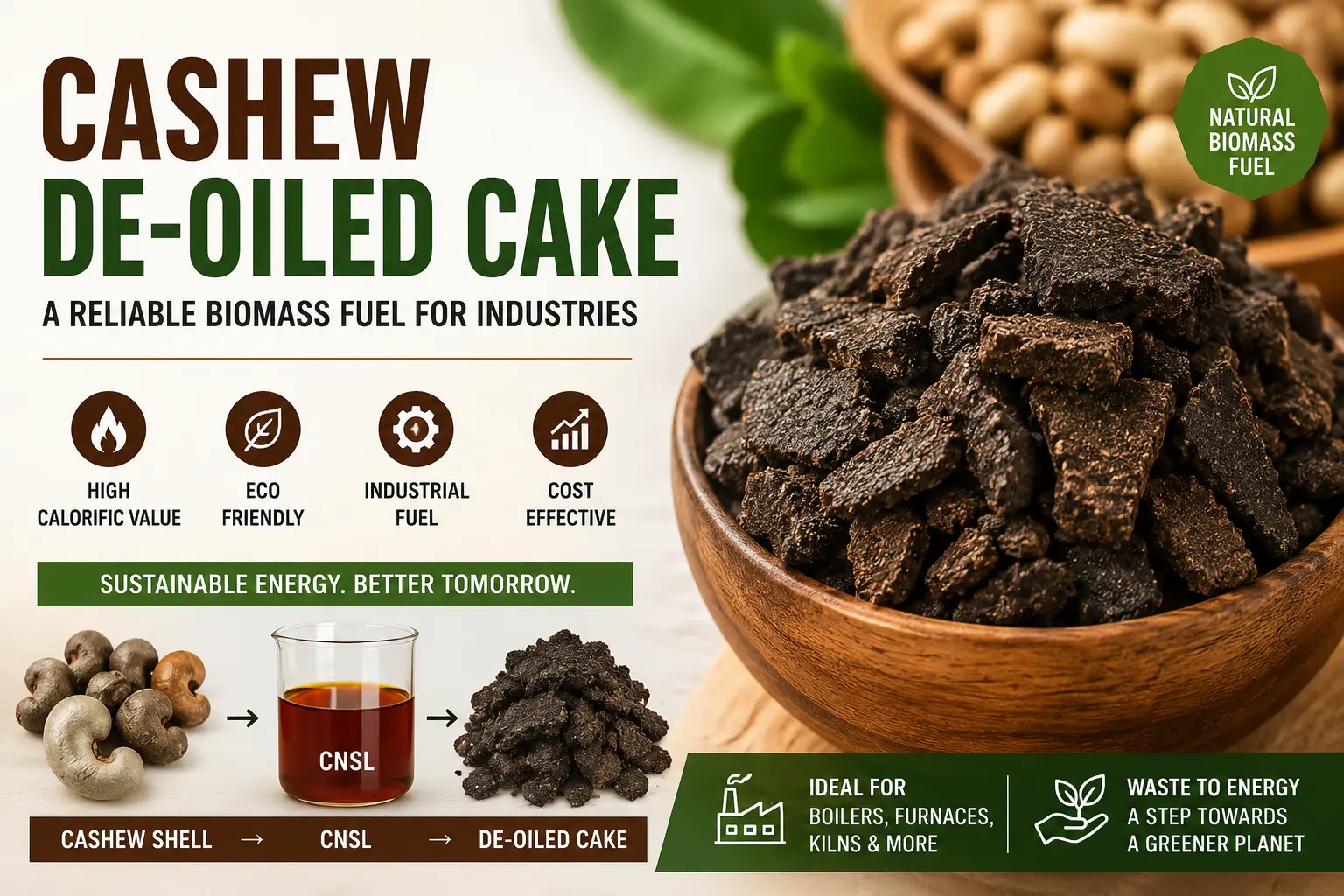
The exact characteristics of the resulting cake depend on the processing method and how much oil/residual material remains.
The Central Pollution Control Board's cashew-industry documentation describes the oil-extracted shell as "de-oiled cake" and notes its use as fuel, with a reported calorific value in that particular process description.
Why should buyers care?
Because "Cashew De Oiled Cake" is not enough information by itself.
Ask the supplier:
Is the product actually de-oiled?
What extraction process is used?
What is the expected residual oil/CNSL content?
Is the material suitable for your specific boiler or furnace?
Can the supplier provide product specifications?
Understanding the processing method helps you compare suppliers properly instead of comparing products based only on their names.
4. Check Physical Quality and Contamination
Technical specifications tell only part of the story.
You should also look at the physical quality of the material.
Cashew De Oiled Cake may be supplied in different physical forms depending on the manufacturer and processing method. The material can have an irregular, coarse appearance, and its particle size can influence handling and feeding in certain combustion systems.
Before committing to a large order, request a representative sample.
Look for:
Particle Size: Is the material reasonably consistent with the requirements of your fuel-feeding system?
Excessive Dust: Too many fines may create handling and feeding challenges in some facilities.
Foreign Materials: Check for stones, metal pieces, plastic, wood, soil, or other unwanted materials.
Excessive Moisture: The material should match the agreed moisture specification.
Unusual Oiliness: If you're specifically purchasing de-oiled cake, excessive residual oil may warrant further clarification from the supplier.
Overall Consistency
Compare samples from different batches where possible.
For industrial buyers, sample approval before bulk procurement is one of the simplest ways to reduce the risk of receiving a product that doesn't match expectations.
And remember a sample should ideally be evaluated not just visually but against the technical requirements of your own equipment.
5. Evaluate the Supplier's Capacity and Reliability
You can find a supplier offering an attractive price in minutes. Finding a supplier who can consistently deliver the right quality at the required volume is much more important. For manufacturers and industrial buyers, supply reliability can directly affect production planning.
Before selecting a Cashew De Oiled Cake manufacturer or supplier, consider the following.
Production Capacity
Ask whether the supplier can fulfil your monthly or annual requirement. If your factory requires hundreds of tonnes every month, make sure the supplier has the sourcing and processing capacity to support that requirement.
Supply Consistency
Ask how the supplier manages raw material sourcing and seasonal fluctuations.
Quality Control
Find out whether the supplier maintains defined specifications for:
✓ Calorific value
✓ Moisture
✓ Ash
✓ Particle size
✓ Residual oil
✓ Physical quality
Packaging and Transportation
Discuss how the product will be supplied. Depending on your requirement, Cashew De Oiled Cake can be handled in bulk or supplied in suitable bags or other packaging formats. Some industrial suppliers offer jumbo/big- bag formats for bulk handling.
Also clarify:
✓ Minimum order quantity
✓ Delivery schedule
✓ Transportation
✓ Loading arrangements
✓ Delivery location
✓ Storage requirements
Experience With Industrial Buyers
A supplier experienced in industrial applications is more likely to understand the importance of consistent quality and timely deliveries. Ultimately, you are not simply buying a biomass product. You're building a fuel supply chain for your operation.
What Should You Ask Before Buying Cashew de Oiled Cake?
If you're speaking with a manufacturer or supplier for the first time, keep this checklist handy:
What is the calorific value?
What is the moisture percentage?
What is the ash percentage?
Is the product de-oiled?
What is the residual CNSL/oil content?
Can you provide a recent laboratory test report?
What is the typical particle size?
What is the monthly production capacity?
Can you supply consistently in bulk?
What are the packaging and delivery options?
What is the minimum order quantity?
Can you provide a sample before bulk purchase?
Getting clear answers to these questions can help you avoid many common procurement problems.
Price Is Important - But Don't Make It the Only Factor
When comparing Cashew De Oiled Cake suppliers, it is tempting to choose the lowest price per tonne.
But imagine two products:
Supplier A: Lower price, higher moisture, inconsistent quality and uncertain supply.
Supplier B: Slightly higher price, better documented specifications, consistent quality and reliable delivery.
The cheaper product may not necessarily be cheaper after considering actual fuel consumption, handling, cleaning, downtime, and supply disruptions.
That's why industrial buyers should look at total operating value, not just purchase price.
A better comparison considers:
Purchase Price + Calorific Value + Moisture + Ash + Consumption + Handling + Logistics + Supply Reliability
This gives you a more realistic understanding of the product's value.
For industrial buyers, the objective should be predictable performance and dependable supply, not simply the lowest invoice value.
A Quick Look at Top Cashew
For businesses exploring cashew-derived industrial products, Top Cashew is a relevant name to keep on the radar.
The cashew industry produces more than just edible kernels. Its processing chain also creates valuable by-products such as CNSL and de-oiled cashew cake, which can serve different industrial purposes.
Top Cashew can be positioned around this broader cashew value chain, helping industrial buyers understand and source cashew-derived products according to their requirements.
For buyers specifically looking for Cashew De-Oiled Cake, CNSL, or other cashew-based industrial materials, the most important consideration remains the same: clearly defined product specifications and dependable supply.
Why Cashew De Oiled Cake Is Getting Attention
Cashew De Oiled Cake is essentially a way of turning a cashew-processing by-product into a useful industrial resource.
Research and industry sources have documented its potential as a solid fuel, including applications in boilers and other high-energy-use industries. The World Bank has also documented de-oiled cashew cake as a fuel used in cashew processing, tile, and other energy-intensive industries.
Research has additionally explored de-oiled cashew cake as a feedstock for biomass briquettes, highlighting the wider potential of converting cashew-processing residues into usable energy products.
For industries looking at alternative biomass fuels, this makes Cashew de-oiled cake an option worth evaluating based on the specific requirements of their heating system. But again, fuel quality and application compatibility matter.
A product that works well in one industrial setup may require different feeding, combustion, or blending conditions in another.
Final Thoughts
Buying Cashew De-Oiled Cake should never be just a price comparison.
Before placing a bulk order, check the five essentials:
1. Calorific Value
2. Moisture & Ash Content
3. De-Oiling Process & Residual CNSL
4. Physical Quality
5. Supplier Reliability
These factors can help manufacturers, boiler operators, procurement teams, and other industrial buyers make a more informed purchasing decision.
Start with a sample. Review the technical specifications. Test the product for your intended application where appropriate. Discuss delivery and quality expectations clearly with the supplier.
Because when you're buying biomass fuel for an industrial operation, the cheapest tonne isn't always the best tonne.
The better question is:
"Will this product deliver consistent quality, reliable heat, and dependable supply for my operation?"
That's the question that leads to smarter industrial procurement. Looking for quality Cashew De-Oiled Cake for your industrial requirement? Focus on specifications, consistency, and supplier capability before making your bulk purchase.
