
Understanding the Science Behind Activated Carbon Adsorption
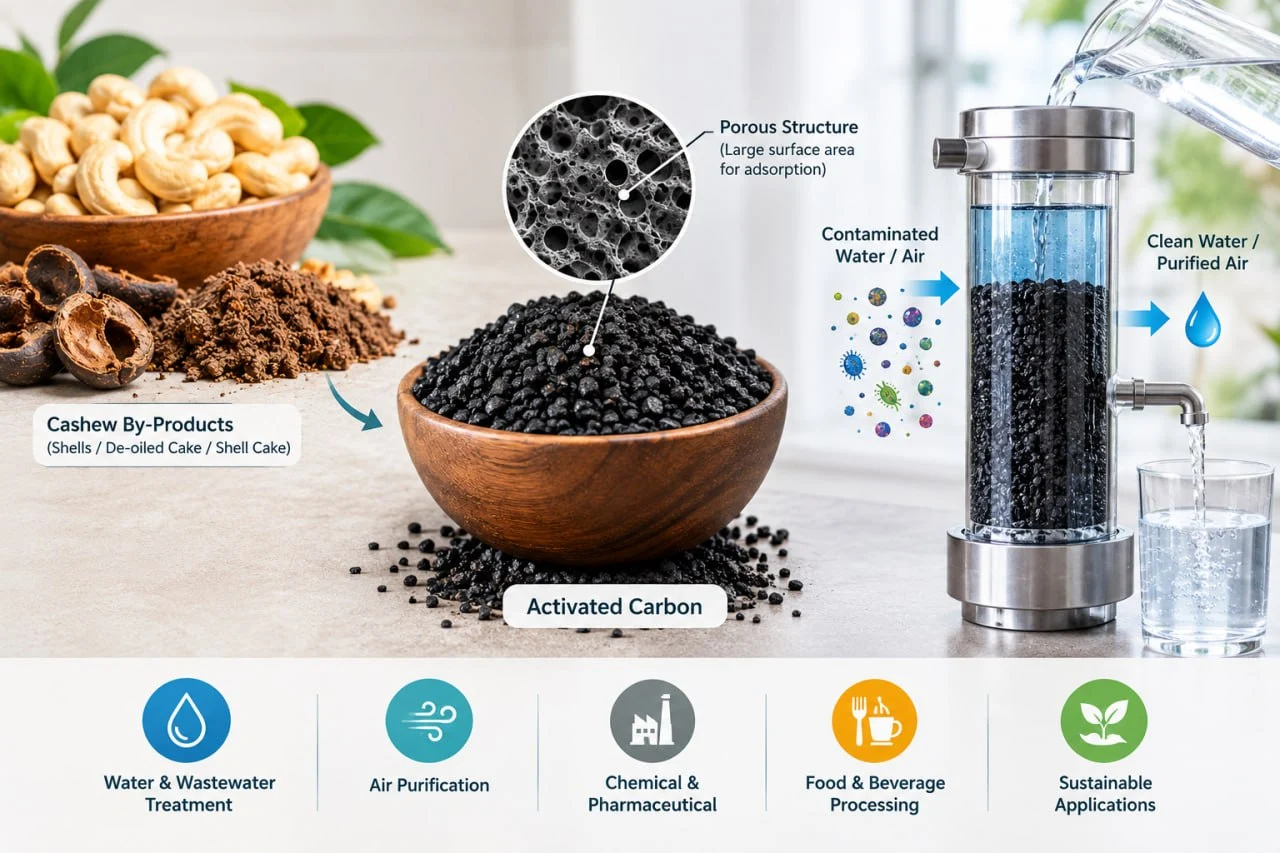
Clean water, fresh air and efficient industrial processes are essential for modern industries. However, removing unwanted chemicals, odours, colours and organic pollutants from water and air remains a major challenge. This is where activated carbon plays an important role.
Activated carbon is widely used in water treatment, air purification, chemical processing and several other industrial applications. Its effectiveness comes from its highly porous structure and ability to attract and hold different contaminants on its internal surfaces.
But how does this process actually work? Why is activated carbon considered such an effective filtration material, and what makes one grade different from another?
Understanding the science behind activated carbon adsorption helps industries select the right filtration media, improve treatment efficiency and make better decisions about material performance.
1. What Is Activated Carbon?
Activated carbon is a carbon-rich material processed to develop an extensive network of tiny pores. These pores create a large internal surface area, allowing the material to capture and retain a wide range of unwanted substances.
It can be manufactured from different carbon-rich raw materials, including coal, coconut shells, wood and certain agricultural by-products. The selection of an appropriate Activated Carbon Raw Material plays an important role in determining the final product's characteristics and adsorption performance.
The manufacturing process generally involves two important stages: carbonization and activation.
Carbonization: The raw material is heated under controlled conditions with limited oxygen. This removes volatile components and produces a carbon-rich structure.
Activation: The carbonized material undergoes physical or chemical treatment to develop and open up its pore structure. Steam and carbon dioxide are commonly used in physical activation, while selected chemical agents are used in chemical activation.
The result is a porous material with a high adsorption capacity. Depending on its raw material and processing conditions, activated carbon can be developed for different industrial requirements.
2. How Does Activated Carbon Adsorption Work?
The most important principle behind activated carbon filtration is adsorption.
Adsorption is a surface phenomenon in which molecules from a liquid or gas attach themselves to the surface of a solid material. In this case, unwanted substances are attracted to the internal surfaces of activated carbon.
It is important to understand the difference between adsorption and absorption. Absorption involves a substance entering the bulk of another material, whereas adsorption occurs mainly on its surface.
Activated carbon works because its internal pore network provides an enormous amount of surface area. As contaminated water or air passes through the carbon, suitable pollutant molecules move towards its surface and become attached to available adsorption sites.
The process generally involves three stages:
1. Surface Transport: Contaminant molecules move from the surrounding liquid or gas towards the outer surface of the activated carbon particles.
2. Pore Diffusion: These molecules travel through the interconnected pores and reach the internal surfaces of the carbon.
3. Surface Attachment: The molecules attach to available adsorption sites through different molecular interactions.
This process allows activated carbon to capture many organic compounds, dissolved impurities and unwanted odour-causing substances, depending on the carbon grade and operating conditions.
3. The Role of Pore Structure in Adsorption
Not all activated carbon performs in the same way. One of the most important factors influencing its performance is its pore size distribution.
According to the IUPAC classification, activated carbon pores are generally divided into three categories:
Micropores: Smaller than 2 nanometres. They provide a significant portion of the adsorption capacity for smaller molecules.
Mesopores: Between 2 and 50 nanometres. They help transport larger molecules towards internal adsorption sites.
Macropores: Larger than 50 nanometres. They act as transport channels that help molecules enter the particle structure.
A well-developed pore network is important because different contaminants have different molecular sizes and properties.
For example, smaller organic molecules may access micropores, while larger molecules may require wider pores. Therefore, a carbon with a high total surface area does not automatically guarantee the best performance for every application.
The pore structure must match the type of contaminant being removed.
4. Physical and Chemical Mechanisms of Adsorption
Activated carbon adsorption involves different types of molecular interactions.
Physical Adsorption
Physical adsorption mainly occurs through relatively weak intermolecular forces, particularly Van der Waals forces. These interactions attract contaminant molecules towards the carbon surface.
It is generally reversible, meaning that under suitable conditions, adsorbed substances can be released from the carbon.
Chemical Adsorption
Chemical adsorption involves stronger interactions, sometimes including chemical bond formation between the contaminant and functional groups on the carbon surface.
The chemical composition and surface properties of activated carbon can influence these interactions.
In practical filtration systems, physical adsorption is often the dominant mechanism for many organic contaminants. However, the actual mechanism depends on the substance being treated and the properties of the carbon.
5. What Factors Influence Activated Carbon Performance?
The adsorption capacity of activated carbon depends on several interconnected factors.
Surface Area: A larger accessible internal surface area can provide more adsorption sites. However, surface area alone cannot determine the overall performance.
Pore Size Distribution: The pores must be suitable for the molecular size and structure of the target contaminant.
pH of the Solution: Changes in pH can influence the electrical properties of the carbon surface and the chemical form of pollutants, affecting adsorption behaviour.
Temperature: Temperature can influence adsorption equilibrium and the rate of molecular movement. Its effect varies depending on the particular system.
Contact Time: Contaminants require sufficient time to reach adsorption sites. Inadequate contact time can reduce treatment efficiency.
Contaminant Concentration: The concentration of pollutants affects adsorption behaviour and the rate at which available sites become occupied.
Understanding these factors helps industries select the appropriate activated carbon grade and design more efficient treatment systems.
6. Where Is Activated Carbon Used in Industries?
The adsorption properties of activated carbon make it useful across several industrial sectors.
Water and Wastewater Treatment
Activated carbon is used to reduce organic contaminants, colour, taste and odour-causing compounds in water. It is also applied in industrial wastewater treatment to remove selected dissolved organic pollutants.
Air Purification
In air treatment systems, activated carbon helps capture volatile organic compounds (VOCs), odours and selected gaseous contaminants. Its performance depends on humidity, temperature, gas composition and carbon characteristics.
Solvent Recovery
Industries that use organic solvents can employ activated carbon systems to capture selected solvent vapours from exhaust streams. Under suitable operating conditions, the captured solvents may be recovered through controlled regeneration processes.
Food and Beverage Processing
Activated carbon is used in selected purification and decolourisation processes, helping remove unwanted colour compounds, odours and certain organic impurities.
Chemical and Pharmaceutical Industries
It supports purification processes where specific organic impurities, residual colour and unwanted compounds need to be reduced.
The selection of carbon must always be based on the actual process requirements and treatment objectives.
7. Understanding Activated Carbon Quality and Testing
Choosing activated carbon based only on its appearance or price can lead to poor treatment results. Technical testing is essential to understand its properties and suitability.
Some important performance indicators include:
Iodine Number: Commonly used as an indicator of adsorption capacity associated with smaller pores.
BET Surface Area: Estimates the specific surface area using gas adsorption measurements.
Pore Size Distribution: Helps identify the proportion of micropores, mesopores and macropores.
Moisture Content: Indicates the amount of water present in the material.
Ash Content: Measures the inorganic residue remaining after combustion.
Hardness and Particle Size: Important for evaluating physical durability, pressure drop and suitability for filtration equipment.
These parameters should be considered together rather than independently. Application-specific testing is also important because laboratory measurements do not always translate directly into real industrial performance.
8. Regeneration and Sustainable Use of Activated Carbon
Activated carbon has a finite adsorption capacity. Over time, its available adsorption sites become occupied by contaminants, reducing its effectiveness. This condition is commonly described as saturation or exhaustion.
Depending on the application and contaminant, spent activated carbon may be replaced or sent for regeneration.
Thermal reactivation is one established method. It uses controlled high-temperature treatment to remove or destroy adsorbed organic compounds and restore part of the carbon's adsorption capacity.
However, regeneration can cause some material loss and changes in pore structure. Its suitability depends on the contaminants captured, the carbon grade and operating conditions.
Sustainable manufacturing is another important part of the discussion. Exploring agricultural residues and industrial by-products as alternative carbon-rich feedstocks can support resource efficiency and reduce dependence on conventional raw materials.
9. Cashew Nut By-Products and Their Role in Sustainable Industrial Applications
The cashew processing industry generates several valuable by-products that can be utilized across different industrial sectors. These Cashew Nut By-Products offer opportunities for resource recovery, waste reduction and value-added manufacturing.
One important product is Cashew Nut Shell Liquid (CNSL), a naturally occurring oil extracted from cashew shells. Also commonly known as Cashew Shell Oil, CNSL has applications in resin manufacturing, friction materials, coatings and other industrial formulations.
Its industrial importance has created demand for reliable manufacturers and suppliers. Businesses looking for a CNSL Manufacturer in India, CNSL Supplier in India or Cashew Nut Shell Liquid Manufacturer often consider product consistency, quality specifications and supply reliability when selecting a business partner.
CNSL is also used as a raw material in CNSL for Resin Manufacturing, where its chemical properties make it suitable for developing specialized industrial resins. A dependable CNSL Oil Supplier can support manufacturers requiring consistent raw material availability.
Another important cashew processing by-product is De-oiled Cake. After oil extraction, the remaining solid material can be processed and supplied for suitable industrial applications. A reliable Cashew De Oiled Cake Manufacturer and Cashew De Oiled Cake Supplier in India can help connect this processing residue with industries exploring alternative raw materials.
Depending on its composition and processing quality, this material may also be considered for applications involving biomass utilization and carbon-based material development.
10. Cashew Shell Cake: Exploring Industrial and Biomass Applications
Cashew Shell Cake is another material associated with cashew shell processing. Its potential applications depend on its composition, processing method and intended end use.
Processed shell residues may be explored as Cashew Nut Shell Biomass Fuel for suitable industrial heating applications. Their calorific value, moisture, ash content and combustion characteristics should be evaluated before use.
Industries looking for a dependable Industrial Biomass Fuel Supplier may consider agricultural and agro-industrial residues as alternative fuel resources, subject to equipment compatibility and applicable environmental requirements.
Similarly, businesses searching for a Cashew Nut Shell Cake Manufacturer should evaluate product consistency, moisture levels, particle size and quality specifications before choosing a supplier.
It is important to distinguish between these materials and activated carbon feedstocks. Although cashew shell residues and De-oiled Cake offer opportunities for industrial value addition, they are not automatically equivalent to finished activated carbon. Carbonisation, activation and laboratory testing are necessary to establish their suitability for specific adsorption applications.
11. The Potential of De-oiled Cake in Activated Carbon Development
The search for more sustainable industrial materials has increased interest in agricultural by-products as potential raw materials for activated carbon.
De-oiled Cake can be explored as a carbon-rich feedstock for developing value-added carbon materials. However, its suitability depends on its composition, carbon yield, ash content, activation response and the quality of the final product.
Proper processing and laboratory evaluation are necessary before establishing its industrial performance.
Top Cashews Pvt. Ltd. focuses on creating value from cashew processing resources, including De-oiled Cake, and exploring opportunities for sustainable industrial applications.
Through material development, research and customized formulations, the company aims to connect agricultural by-products with evolving industrial requirements for activated carbon and related applications.
The broader opportunity lies in combining responsible resource utilization with consistent product quality and application-specific performance.
Conclusion
Activated carbon adsorption is much more than a simple filtration process. Its effectiveness depends on the relationship between pore structure, surface chemistry, molecular interactions and operating conditions.
From industrial water treatment and air purification to solvent recovery and chemical processing, understanding these principles helps businesses make informed decisions about filtration materials.
At the same time, cashew processing by-products such as CNSL, Cashew Nut Shell Cake and Cashew De-oiled Cake demonstrate the potential of agricultural resources in supporting industrial applications and sustainable manufacturing.
With appropriate processing, testing and product development, these resources may contribute to the next generation of industrial materials.
At Top Cashews Pvt. Ltd., the focus is on exploring the value of cashew-derived resources and supporting sustainable material innovation for evolving industrial needs.
