
CNSL in Resin Manufacturing: Properties, Benefits, Applications & Industrial Uses
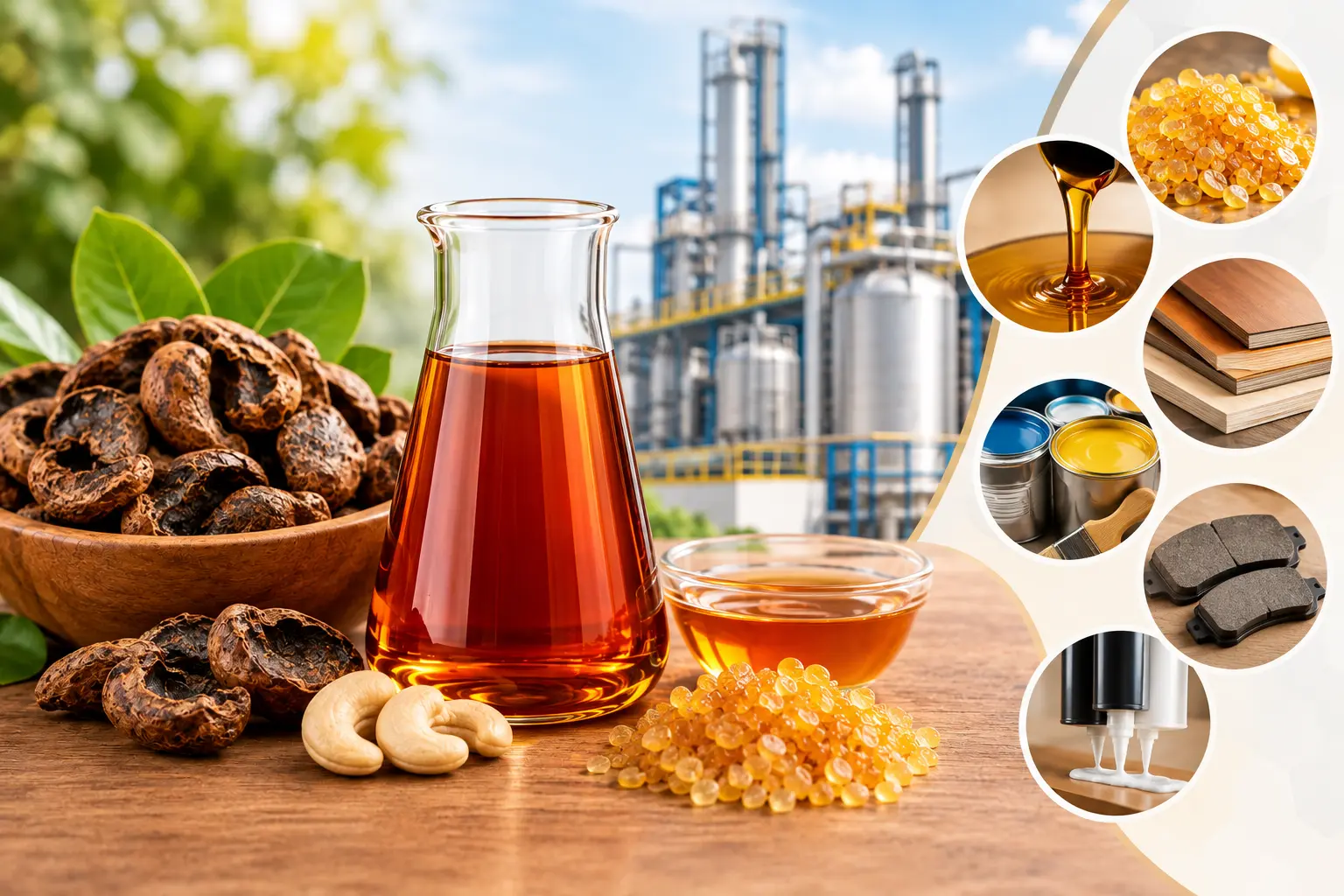
Resin manufacturing has traditionally relied on petroleum-based raw materials and synthetic chemicals. But as industries look for more sustainable, versatile, and cost-effective alternatives, Cashew Nut Shell Liquid (CNSL) is gaining attention as a valuable bio-based raw material.
CNSL is extracted from cashew shells, a by-product of the cashew processing industry. What makes it particularly interesting for resin manufacturers is its rich content of phenolic compounds, especially cardanol, cardol, and anacardic acid.
These natural compounds can be chemically modified to produce materials used in phenolic resins, epoxy systems, coatings, adhesives, friction materials, laminates, and other industrial applications.
So, how exactly does CNSL work in resin manufacturing, and why are manufacturers increasingly exploring CNSL-based resin systems?
Let’s take a closer look.
Cashew Nut Shell Liquid (CNSL) is a naturally occurring liquid found in the honeycomb structure of cashew shells. It is recovered during cashew nut processing and is considered one of the most commercially important agricultural by-products used in the chemical industry.
Depending on the extraction and processing method, CNSL can contain different proportions of anacardic acid, cardanol, cardol, and related phenolic compounds.
Among these, cardanol is especially important for resin manufacturing.
Cardanol contains a phenolic ring along with a long unsaturated hydrocarbon side chain. This chemical structure gives it useful characteristics that allow it to participate in various chemical reactions and modifications.
Because of this, CNSL has become an important renewable feedstock for producing specialty resins and industrial materials.
Why Is CNSL Used in Resin Manufacturing?
The main reason manufacturers are interested in CNSL is its combination of phenolic chemistry and renewable origin.
Conventional phenolic materials often depend heavily on petroleum-derived phenol. CNSL-derived compounds, particularly cardanol, can be used to develop modified phenolic systems with different performance characteristics.
Here are some important reasons CNSL is used in resin manufacturing:
1. Renewable Raw Material
CNSL comes from cashew shells, which are generated in large quantities during cashew processing.
Instead of allowing this agricultural by-product to remain underutilized, it can be converted into a valuable industrial raw material.
This creates an opportunity to develop more bio-based resin systems while also adding value to cashew processing waste.
2. High Phenolic Reactivity
The phenolic structure of CNSL-derived materials makes them suitable for chemical modification.
Cardanol, for example, can be used in reactions involved in producing phenolic resins, epoxy modifiers, polyurethane materials, and other specialty polymers.
3. Flexible Chemical Structure
Cardanol's long hydrocarbon side chain gives it properties that differ from conventional phenol.
The unsaturation in the side chain also provides opportunities for further chemical modification, allowing manufacturers to develop materials for specific industrial requirements.
4. Useful Performance Characteristics
Depending on formulation and processing, CNSL-based resin systems can offer properties such as good flexibility, chemical resistance, water resistance, adhesion, and thermal performance.
The exact performance depends on the CNSL grade, chemical modification, resin formulation, curing system, and intended application.
.webp?alt=media&token=40bd4dfc-aea3-4e7b-866e-5b2f1b3cc589)
When discussing CNSL in resin manufacturing, cardanol deserves special attention.
Cardanol is obtained through the processing of CNSL, particularly through decarboxylation of anacardic acid. It is a phenolic compound with a long hydrocarbon side chain.
This combination makes cardanol useful for developing specialty polymer materials.
In resin production, cardanol can be chemically modified to create different types of resin intermediates and finished systems.
For example, cardanol can be incorporated into:
Phenolic resins
Epoxy resins
Polyurethane systems
Alkyd resins
Coating materials
Adhesives
Friction materials
Specialty polymers
This versatility is one of the main reasons cardanol-based resin technology has attracted interest across several industries.
CNSL-Based Phenolic Resins
One of the established areas of CNSL application is phenolic resin manufacturing.
Phenolic resins are widely used in industrial applications because of their combination of mechanical strength, thermal resistance, chemical resistance, and durability.
CNSL-derived materials can be incorporated into phenolic resin formulations to modify their characteristics.
Depending on the formulation, CNSL-based phenolic resins may provide improved flexibility and processing characteristics compared with conventional phenolic systems.
They can be used in applications such as:
Friction materials
Brake linings
Clutch components
Foundry applications
Abrasive materials
Laminates
Industrial adhesives
Protective coatings
The actual properties of the final resin depend strongly on formulation chemistry and processing conditions.
CNSL in Epoxy Resin Systems
Another important area is the use of cardanol and CNSL derivatives in epoxy resin systems.
Cardanol can be chemically modified to produce epoxy-functional materials and reactive diluents. These materials can be incorporated into epoxy formulations to modify properties such as flexibility, viscosity, adhesion, and chemical resistance.
This makes CNSL derivatives interesting for applications involving:
Industrial coatings
Marine coatings
Protective coatings
Adhesives
Flooring systems
Electrical materials
Composite applications
For manufacturers, the advantage is not simply that CNSL is bio-based. Its real value comes from the ability to chemically modify it and tailor the resulting material for specific applications.
CNSL for Industrial Coatings
Coatings are another major application area for CNSL-based resin technology.
Industrial coatings need to withstand challenging conditions such as moisture, chemicals, abrasion, temperature changes, and prolonged exposure to the environment.
Cardanol-based materials can be used in coating formulations where properties such as adhesion, flexibility, water resistance, and chemical resistance are important.
CNSL derivatives are therefore explored in:
Anti-corrosion coatings
Marine coatings
Protective coatings
Floor coatings
Industrial paints
Metal coatings
The long hydrocarbon chain of cardanol can contribute to flexibility and hydrophobic characteristics, while its phenolic structure provides opportunities for further chemical reactions.
CNSL in Adhesive Manufacturing
Adhesives are another area where CNSL-derived materials can play a role.
Industrial adhesives need a balance of adhesion, flexibility, durability, chemical resistance, and processing characteristics.
CNSL derivatives can be incorporated into certain adhesive formulations to modify these properties.
They are particularly relevant for specialty adhesive systems used in industrial environments, wood products, construction materials, laminates, and other applications.
Again, the performance depends on the complete formulation rather than CNSL alone.
CNSL in Friction Materials
The friction-material industry is an important application for CNSL-based phenolic resins.
Brake pads, clutch facings, brake linings, and other friction products require materials that can tolerate heat, pressure, friction, and repeated mechanical stress.
Phenolic resins are commonly used as binders in these products. CNSL-derived materials can be incorporated into resin systems to help modify properties such as flexibility, toughness, processing behavior, and friction performance.
This has made CNSL an interesting raw material for manufacturers of:
Brake pads → Clutch plates → Brake linings → Friction blocks → Abrasive products
.webp?alt=media&token=5ee0b7f1-aa61-404a-9a0f-63d5059c88e9)
The growing interest in CNSL is driven by a combination of technical and sustainability factors.
Bio-Based Origin
CNSL is derived from a renewable agricultural resource rather than being produced entirely from fossil-based feedstocks.
Waste Valorization
Cashew shells are a major by-product of cashew processing. Converting them into industrial chemicals creates additional value from an existing resource.
Chemical Versatility
CNSL contains compounds that can be modified to produce different intermediates and resin systems.
Potential for Tailored Formulations
Cardanol and other CNSL derivatives can be chemically modified according to the requirements of the final application.
Wide Industrial Applications
From coatings and adhesives to friction materials and specialty polymers, CNSL derivatives can serve multiple industrial markets.
Factors to Consider When Buying CNSL for Resin Production
For resin manufacturers, selecting the right CNSL supplier is just as important as selecting the right chemistry.
CNSL quality can vary depending on the source, extraction process, storage conditions, and degree of processing.
Before purchasing cashew nut shell liquid for industrial use, manufacturers should evaluate:
CNSL grade
Anacardic acid content
Cardanol content
Cardol content
Moisture level
Viscosity
Specific gravity
Acid value
Processing method
Batch consistency
Packaging
Storage conditions
Technical documentation
Quality testing
Supply capacity
A reliable CNSL manufacturer in India should be able to provide consistent material along with relevant technical specifications and quality documentation.
For large-scale resin manufacturing, consistency is particularly important because changes in raw-material chemistry can affect reaction behavior and the properties of the finished resin.
CNSL vs Conventional Phenolic Raw Materials
CNSL should not simply be viewed as a direct replacement for every conventional resin raw material.
Instead, it is better understood as a versatile bio-based feedstock that can be chemically modified and incorporated into specific resin formulations.
Traditional phenol-based systems offer well-established performance and manufacturing processes. CNSL-derived materials bring different chemical characteristics and the potential for renewable content.
The right choice depends on the intended application, formulation requirements, processing conditions, cost targets, and performance specifications.
For manufacturers, laboratory trials and application-specific testing are essential before moving to commercial production.
Future of CNSL in Resin Manufacturing
The demand for renewable raw materials is encouraging manufacturers to look beyond conventional petroleum-based chemistry.
CNSL has an interesting position in this transition because it combines renewable sourcing, chemical versatility, and industrial applicability.
Research and development are continuing around cardanol-based polymers, bio-based epoxy systems, phenolic resins, coatings, adhesives, composites, and other specialty materials.
As industries focus more on resource efficiency and circular manufacturing, agricultural by-products such as cashew shells can become increasingly valuable sources of industrial chemicals.
This does not mean CNSL will replace conventional raw materials across every resin application. Instead, its future is likely to involve carefully designed formulations where its specific chemical properties provide a technical or sustainability advantage.
