
Sustainable Utilization of Cashew Processing Waste
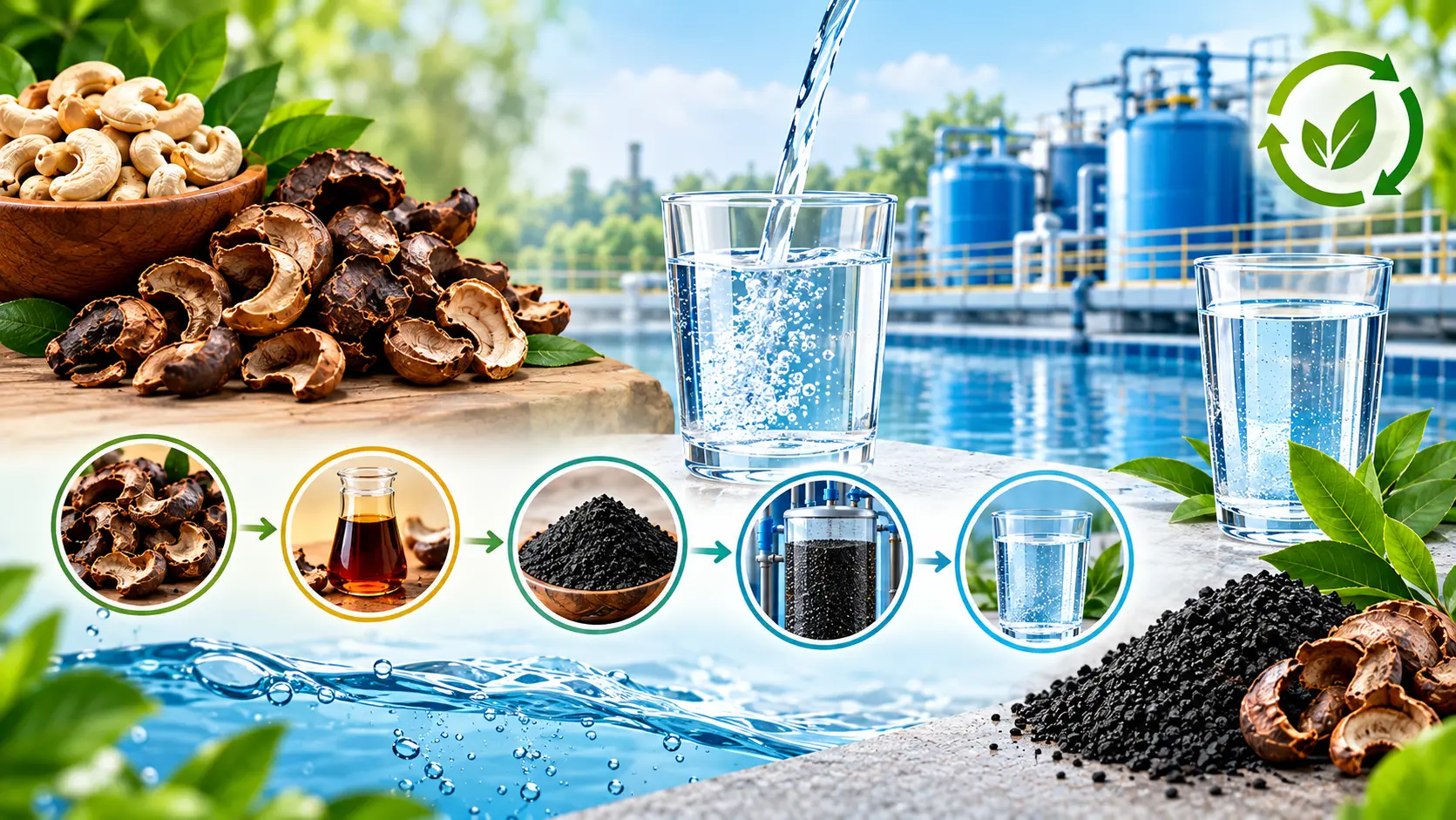
The cashew industry is an important part of the global agricultural and food-processing sector. Cashew nuts are widely consumed as snacks, ingredients, and raw materials for different food products.
However, behind every processed cashew kernel is a considerable amount of agricultural residue, including cashew nut shells, testa, cashew apple residues, shell liquid, and other processing by-products.
Traditionally, much of this material has been treated as waste or used for low-value purposes. With increasing attention toward resource efficiency, waste reduction, and the circular economy, the focus is shifting from simply disposing of these residues to finding productive ways to use them.
Sustainable utilization of cashew processing waste means recovering useful materials from these residues and converting them into products with industrial, environmental, or commercial value. This approach can reduce waste while creating additional revenue opportunities for processors and supporting more sustainable production systems.
Understanding Cashew Processing Waste
Cashew processing generates several different types of residues. The most visible is the cashew nut shell, which surrounds the edible kernel. During processing, the shell is separated from the kernel and can accumulate in significant quantities.
Another important material is the reddish-brown testa or husk that remains around the kernel. Cashew apples and their processing residues can also become underutilized resources, particularly in regions where the fruit is not fully commercialized.
Among these residues, the cashew nut shell has attracted considerable interest because it contains cashew nut shell liquid (CNSL). This naturally occurring liquid contains phenolic compounds such as anacardic acid, cardanol, and cardol. Research has identified CNSL as a renewable raw material with potential applications across several industrial sectors.
Instead of viewing these materials only as waste, they can be considered potential feedstocks for a range of value-added products.
Why Sustainable Waste Utilization Matters
Improper handling of agricultural residues can create storage, disposal, and environmental challenges. Large quantities of organic waste require space and appropriate management. If valuable components are not recovered, an opportunity to generate additional economic value is also lost.
Sustainable utilization provides a different approach. Rather than following a simple “process and discard” model, processors can explore ways to recover useful compounds, energy, materials, and secondary products.
This creates a more circular system in which one part of the cashew processing chain can become the raw material for another application.
A circular approach can offer several potential benefits:
Reduction in agricultural waste
Better utilization of renewable resources
Development of value-added products
Additional income opportunities for processors
Reduced dependence on certain conventional raw materials
Support for resource-efficient manufacturing
The concept is increasingly relevant as industries look for practical ways to combine economic activity with responsible resource management.
Cashew Nut Shell Liquid: A Valuable By-Product
One of the most important opportunities in cashew waste utilization is the recovery of CNSL from cashew nut shells.
CNSL is a dark, viscous liquid found within the shell structure. Its chemical composition gives it characteristics that are useful for industrial processing. Research has explored CNSL and its derivatives for applications involving coatings, adhesives, resins, polymers, rubber-related materials, friction materials, and other chemical products.
The value of CNSL comes from its naturally occurring phenolic compounds. Through appropriate processing and chemical modification, these compounds can be converted into materials designed for specific industrial applications.
For example, cardanol obtained from CNSL has been investigated as a renewable feedstock for polymer-related products. CSIR-NIIST has also developed a biorefinery approach for producing value-added materials from this cashew industry by-product.
This demonstrates an important principle of sustainable manufacturing: an agricultural residue does not necessarily have to remain a low-value material. With suitable technology, it can become a useful industrial feedstock.
Converting Cashew Shell Residues into Activated Carbon
Another promising application is the production of activated carbon from cashew shell waste.
Activated carbon is a porous carbonaceous material widely studied for adsorption applications. Its porous structure allows it to interact with and retain certain contaminants and molecules.
Researchers have investigated the conversion of cashew shell residues into activated carbon for applications such as the removal of heavy metals and dyes from water. One study demonstrated an integrated approach in which CNSL was first extracted from cashew shells and the remaining solid material was subsequently used for activated carbon production.
This type of approach is particularly interesting because it can improve resource efficiency. Instead of extracting one valuable component and discarding the remaining shell, multiple useful products can potentially be recovered from the same biomass.
Such a model moves cashew processing closer to a biorefinery concept, where different components of an agricultural residue are separated and converted into products with different applications.
Energy and Fuel Potential
Cashew processing residues also have potential as sources of energy because biomass contains stored chemical energy.
Cashew shells and other organic residues can be considered for thermal conversion or other biomass-based energy applications, depending on their composition, moisture content, processing method, and local regulations.
However, simply burning agricultural residues is not always the highest-value option. Where economically and technically practical, recovering valuable chemicals or materials before using the remaining biomass for energy can provide a more comprehensive utilization strategy.
The goal should therefore be to identify the most efficient pathway for each fraction of the waste stream rather than treating every residue in the same way.
Utilization of Cashew Husk and Testa
The shell is not the only valuable residue generated during cashew processing. Cashew husk or testa also contains organic compounds and structural components that can potentially be used in value-added applications.
Recent research has examined cashew husk as a renewable material for different products and chemical applications. Its composition and structural characteristics make it an area of interest for sustainable material development.
Further research and commercial development could help transform these less-utilized residues into useful materials rather than allowing them to remain part of the waste stream.
Cashew Apple and Other Processing Residues
Cashew processing is associated with more than shell waste. The cashew apple and its residues can also represent an important resource.
Because cashew apple is highly perishable, it is not always fully utilized in commercial supply chains. Processing can generate residues such as bagasse, which contains organic and lignocellulosic material.
Research has explored the potential of cashew apple residues for biological processes and the production of materials such as bioethanol and other microbial products.
Better utilization of these materials could help improve overall resource efficiency in cashew-producing regions.
Moving from Waste Management to Resource Management
The biggest shift required is conceptual. Cashew processing waste should not always be viewed simply as something that needs to be removed.
Instead, processors can consider these residues as a portfolio of raw materials.
For example, a processing facility could potentially separate shell-based materials for CNSL recovery, use the remaining biomass for carbon-based products, and explore
other residues for energy or biological applications. Such integrated systems can increase the value extracted from every tonne of raw material.
However, implementation requires careful consideration of processing costs, transportation, technology availability, product quality, market demand, and environmental performance.
Challenges in Sustainable Utilization
Although the opportunities are significant, sustainable utilization is not without challenges.
The composition of agricultural residues can vary depending on cashew variety, cultivation conditions, processing techniques, storage, and geographical location. This variability can affect the consistency of recovered materials.
Scaling laboratory technologies into commercially viable operations is another challenge. A process that works under controlled laboratory conditions may require significant investment before it can operate efficiently at industrial scale.
There are also questions related to collection, transportation, storage, quality control, and market development. For value-added products to become commercially successful, the complete supply chain must be considered.
Therefore, sustainable utilization should be approached through a combination of scientific research, process optimization, economic assessment, and responsible environmental management.
The Role of a Circular Economy
The sustainable use of cashew processing residues fits naturally into the principles of a circular economy.
Instead of extracting resources, producing a product, and discarding the remaining materials, a circular approach aims to keep resources in productive use for as long as possible.
In the cashew sector, this could mean recovering CNSL, converting shell residues into activated carbon, utilizing organic residues for biological applications, and exploring other value-added products.
The objective is not simply to reduce the amount of waste. It is to extract greater value from the resources already available.
This approach can also support innovation in rural and agricultural economies by creating new opportunities around processing, material recovery, manufacturing, and supply chains.
The Future of Cashew Waste Utilization
The future of cashew processing is likely to involve greater integration between food production, material recovery, and industrial applications.
Technologies that allow multiple products to be obtained from the same residue are particularly promising. Research is already exploring CNSL-based chemicals, bio-based
materials, activated carbon, coatings, polymers, fuels, and other applications. For businesses, the opportunity lies in identifying applications that are technically reliable, commercially viable, and environmentally responsible.
For researchers, the focus can move toward improving extraction efficiency, developing safer processing methods, standardizing raw materials, and evaluating the complete environmental impact of new products.
For cashew processors, better waste utilization can potentially transform a disposal challenge into an additional resource stream.
Conclusion
Sustainable utilization of cashew processing waste represents an important opportunity to make the cashew industry more resource-efficient and circular.
Cashew shells, CNSL, testa, cashew apple residues, and other by-products should not automatically be considered materials with no further value. Research has demonstrated their potential as sources of chemicals, carbon materials, bio-based products, energy, and other industrial resources.
The most effective approach is to move beyond simple waste disposal and develop integrated systems that recover maximum value from available biomass.
With continued technological development, investment, and responsible processing practices, cashew waste can become more than an environmental challenge. It can serve as a renewable source of raw materials for the next generation of sustainable products.
Ultimately, the future of cashew processing is not only about producing more kernels. It is also about making better use of everything that comes with them.
