
Best Cashew Nut Shell Liquid Suppliers for Industrial Use in India
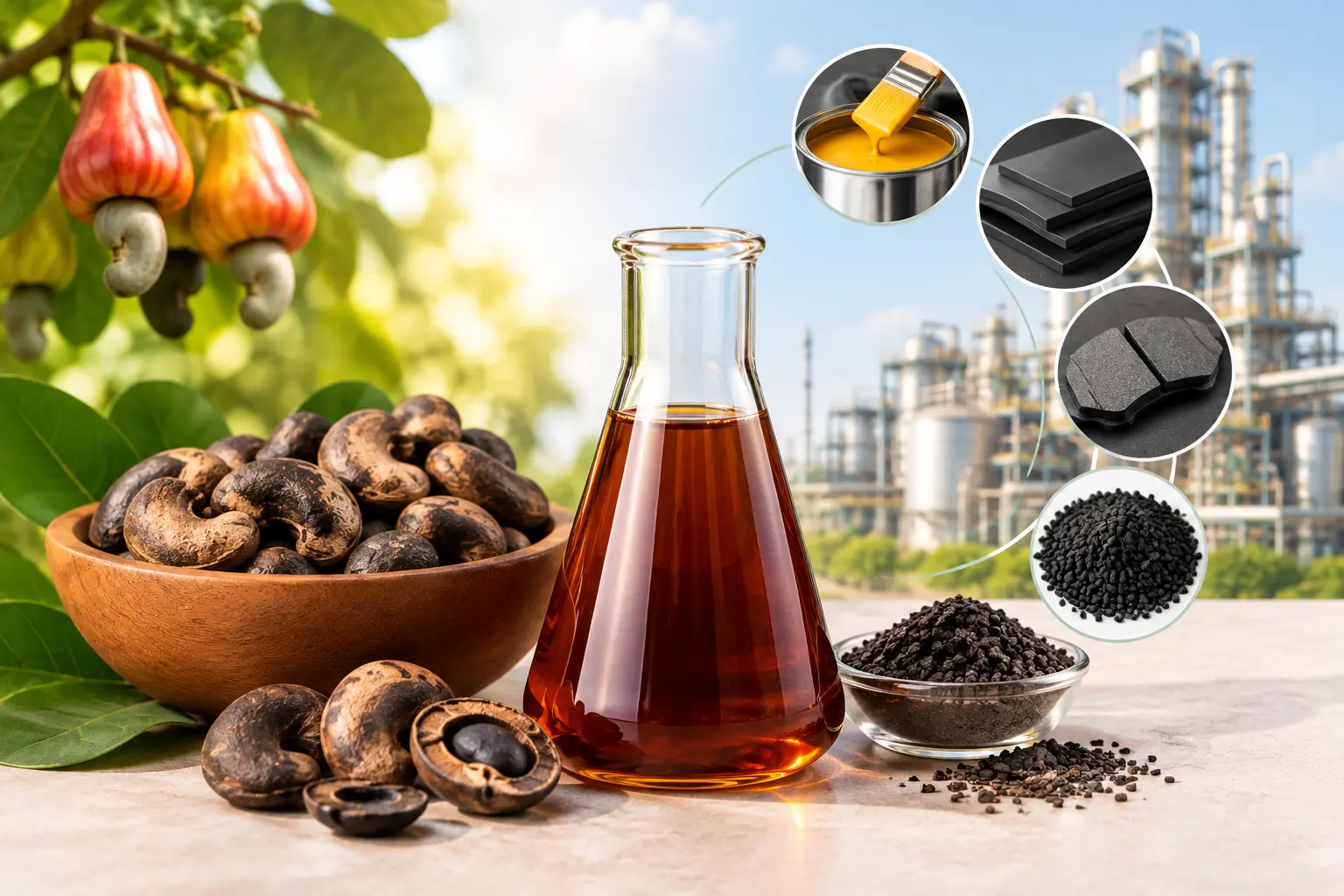
Cashew Nut Shell Liquid (CNSL) has moved far beyond being a simple by-product of the cashew-processing industry. Today, it is an important bio-based industrial raw material used in resins, coatings, friction materials, adhesives, rubber chemicals, laminates, specialty chemicals and other polymer applications.
India is particularly important in the CNSL supply chain because of its established cashew-processing industry. According to APEDA, India's cashew production increased from 794 thousand tonnes in 2023–24 to 802 thousand tonnes in 2024–25. More importantly for industrial buyers, India exported 38,648.74 MT of Cashew Shell Liquid (CNSL) worth US$26.76 million during FY 2025–26. Major export destinations included Vietnam, South Korea, Germany, China and Belgium.
With increasing demand for renewable and bio-based raw materials, the question for manufacturers is no longer simply where to buy CNSL. The more important question is:
How do you choose the right CNSL supplier and the right grade for your industrial application?
This guide compares some Indian CNSL suppliers based on publicly available information and explains the technical parameters, applications, quality checks, supply considerations and procurement questions industrial buyers should consider.
What Is Cashew Nut Shell Liquid?
Cashew Nut Shell Liquid, commonly known as CNSL, is a reddish-brown, viscous liquid found inside the honeycomb-like structure of cashew nut shells.
It is obtained as a by-product during cashew processing. APEDA describes CNSL as the oil obtained from crushing cashew shells, while scientific literature identifies it as a mixture of naturally occurring substituted phenolic compounds.
The major components of CNSL include:
Anacardic acid
Cardanol
Cardol
2-Methyl cardol
The exact composition depends heavily on the extraction and processing method. This is one of the most important points industrial buyers should understand before comparing suppliers.
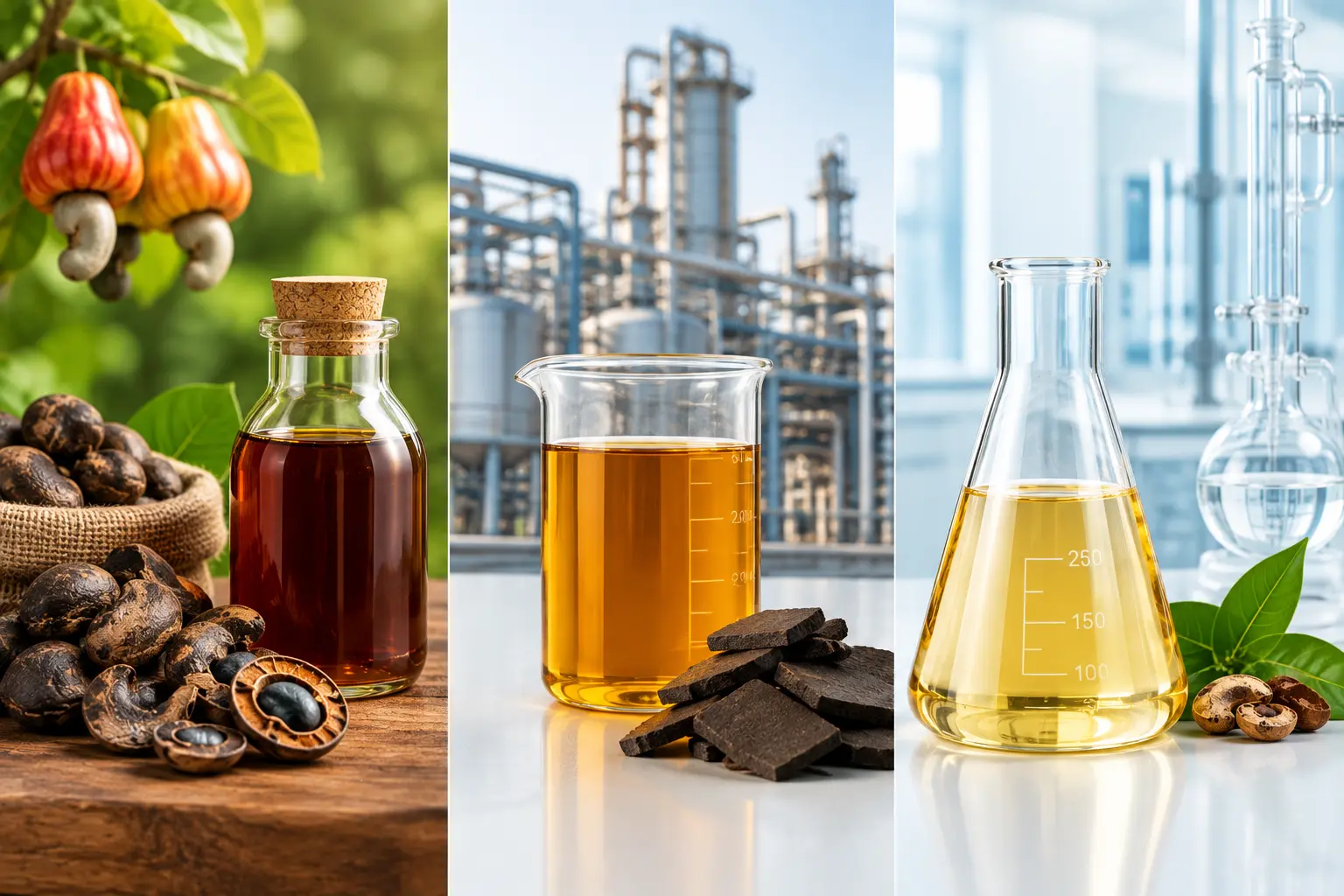
Not all CNSL is chemically identical.
Natural CNSL is generally obtained using relatively mild extraction conditions.
Research literature reports natural CNSL as typically containing approximately:
60–70% anacardic acid
10–20% cardol
Less than 10% cardanol
Around 2–3% 2-methyl cardol
The actual composition can vary depending on extraction conditions and raw material.
Technical CNSL
When CNSL is heated, anacardic acid undergoes decarboxylation and produces cardanol.
Technical CNSL is therefore substantially richer in cardanol. Published research commonly reports approximately:
60–70% cardanol
10–20% cardol
Less than 5% anacardic acid
Around 2–3% 2-methyl cardol
· Some polymeric material depending on processing
These values are indicative ranges from scientific literature, not a universal commercial specification.
Distilled CNSL / Cardanol
Further vacuum distillation can separate and concentrate cardanol.
Research literature reports distilled material at more than 90% cardanol under suitable distillation conditions, while commercial cardanol specifications vary by manufacturer and grade.
Therefore, an industrial buyer should never compare two products simply by calling both of them "CNSL." The grade and chemical profile must be compared first.
Why Cardanol and Cardol Content Matters
The industrial value of CNSL comes largely from its phenolic chemistry and unsaturated C15 side chain.
Cardanol, in particular, is useful as a renewable building block for polymer and specialty-chemical applications.
Its chemical structure allows it to be modified for use in:
Phenolic resins
Epoxy systems
Polyurethanes
Coatings
Adhesives
Surfactants
Friction materials
Rubber formulations
CSIR-NIIST identifies CNSL and its derivatives as useful in friction linings, paints and varnishes, laminating resins, rubber-compounding resins, polyurethane polymers, surfactants, epoxy resins, foundry chemicals and chemical intermediates.
This is why cardanol content, cardol content, anacardic acid level and polymeric material are important when evaluating CNSL suppliers.
Best Cashew Nut Shell Liquid Suppliers in India
There is no single government-certified ranking that officially declares one company the "best CNSL supplier in India." Instead, industrial buyers should compare manufacturers based on product specifications, quality consistency, manufacturing capability, documentation, capacity, logistics and application support.
Based on publicly available information, the following companies are worth evaluating.
1. Top Cashew Pvt. Ltd. – Odisha
Top Cashew Pvt. Ltd. is an Indian manufacturer and supplier listed in Dhenkanal, Odisha.
Public company information lists the business as established in 2017, with products including:
CNSL Resin
Cashew Nut Shell Cake
Cashew Nut Shell Oil
Cashew Nut Shell Liquid/CNSL Oil
The available company listing identifies Top Cashew Pvt. Ltd. as a manufacturer and supplier.
For buyers evaluating Top Cashew as an industrial CNSL partner, the most important next step should be requesting the current technical documentation directly from the company, including:
CNSL grade
Cardanol percentage
Cardol percentage
Anacardic acid content
Polymeric content
Viscosity
Moisture
Ash
Specific gravity
Batch-wise COA
TDS
Packaging options
MOQ
Production/supply capacity
Lead time
Available certifications
This approach is particularly important because publicly available company listings confirm the product categories but do not provide enough current technical information to independently verify a detailed CNSL specification.
For SEO and industrial positioning, Top Cashew can naturally be presented as an Odisha-based supplier of CNSL and cashew-derived industrial products, provided the company's current product specifications are confirmed before publication
CNSL Technical Specification: What Should Buyers Check?
Before placing a bulk order, procurement and technical teams should evaluate at least the following parameters.
Cardanol Content
Important for technical CNSL and downstream cardanol-based applications.
Cardol Content
Useful for understanding the composition and consistency of the material.
Anacardic Acid
Especially important when distinguishing natural CNSL from heat-treated technical CNSL.
Polymeric Material
Higher polymeric content can affect viscosity and processing behaviour.
Viscosity
Important for pumping, mixing, dosing and formulation.
Moisture
Should be controlled according to the application.
Ash
Useful for monitoring inorganic impurities.
Specific Gravity
Helps monitor batch consistency.
Iodine Value
Can provide information about unsaturation and is used in some commercial specifications.
Colour
Relevant for certain coating, resin and specialty applications.
The key point is that one universal CNSL specification does not exist for every application.
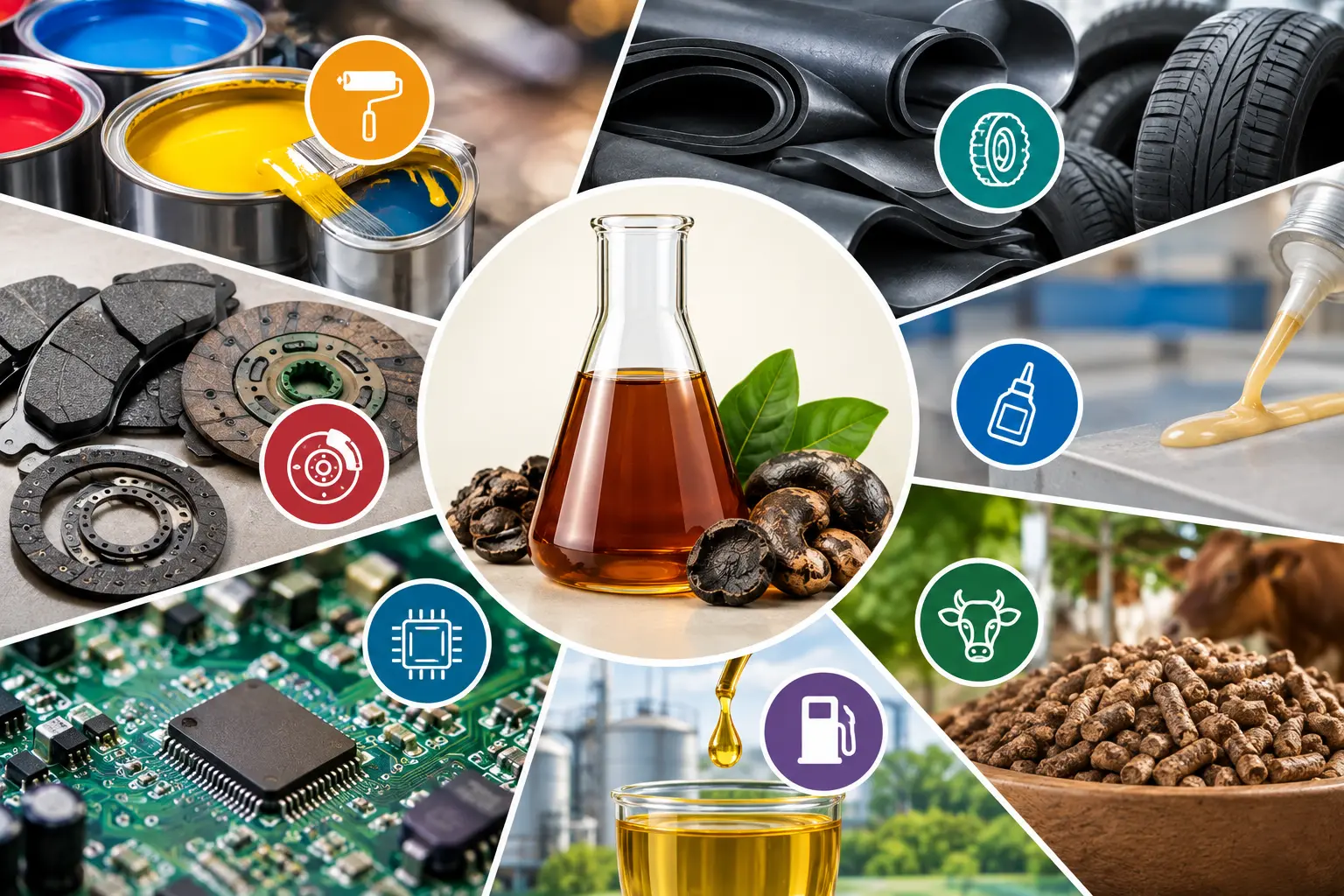
Paints and Coatings
CNSL and cardanol are used in resin and coating systems because of their phenolic functionality and unsaturated side chain.
Applications include industrial coatings, varnishes and protective coating systems.
CSIR-NIIST specifically identifies paints, varnishes and epoxy-related applications among the uses of CNSL derivatives.
Automotive Friction Materials
CNSL-derived materials are widely associated with friction formulations, including brake and clutch-related materials.
This makes consistent chemical composition especially important for automotive manufacturers and friction-material producers.
Resins and Laminates
CNSL is used as a feedstock for phenolic and other resin systems.
Its ability to undergo polymerisation and chemical modification makes it useful in laminates, adhesives and industrial resin formulations.
Epoxy Systems
Cardanol can be converted into reactive diluents and other epoxy-related materials.
CSIR-NIIST reports cardanol-derived reactive diluents designed to improve flexibility and water-resistance characteristics in epoxy systems.
Rubber Chemicals
CNSL and its derivatives are also relevant to rubber-compounding and rubber-resin systems.
Specialty Chemicals
CNSL is increasingly being investigated as a renewable platform for surfactants, polyurethane materials and other specialty chemicals. Research literature describes CNSL as an important renewable starting material because of its availability, structure and chemical versatility.
CNSL and the Circular Economy
One of CNSL's biggest advantages is that it creates value from a cashew-processing by-product.
Instead of treating cashew shells only as waste, processors can recover CNSL and then further convert it into cardanol, resins and other specialty materials.
CSIR-NIIST describes CNSL as a versatile by-product and promotes a biorefinery approach for producing value-added materials from this agricultural by-product.
The opportunity is not limited to chemicals. Recent work in India is also exploring cashew-shell residues for energy, gas and biochar applications, showing how cashew-processing residues can participate in broader circular-economy models.
How Much CNSL Does India Export?
The latest APEDA data provides a useful picture of India's CNSL trade.
During FY 2025–26, India exported:
38,648.74 MT of Cashew Shell Liquid
with an export value of:
US$26.76 million
The major destinations were:
1. Vietnam
2. South Korea
3. Germany
4. China
5. Belgium
APEDA identifies CNSL as a by-product generated during the processing of raw cashew nuts into kernels.
This export activity demonstrates that India is not only a major cashew-processing market but also an important global source of CNSL.
How to Select the Best CNSL Supplier in India
The best supplier for one company may not be the best supplier for another.
A resin manufacturer may prioritise cardanol and polymeric content.
A coating manufacturer may focus on viscosity, colour and chemical consistency.
A friction-material manufacturer may place greater importance on batch-to-batch reproducibility.
A large export buyer may prioritise production capacity, packaging and logistics.
Therefore, evaluate suppliers using the following checklist:
Procurement Parameter - What to Verify
CNSL Grade - Natural / Technical / Refined
Cardanol - Actual percentage
Cardol - Actual percentage
Anacardic Acid - Actual percentage
Polymer Content - Maximum/typical value
Viscosity - Value + test temperature
Moisture - Maximum level
Ash - Maximum level
Specific Gravity - Test value
Iodine Value - Applicable specification
COA - Batch-wise availability
TDS - Current version
Sample - Pre-order sample
Capacity - Monthly available supply
MOQ - Minimum order
Packaging - Drum/IBC/Flexibag/Bulk
Lead Time - Confirmed delivery schedule
Certifications - Relevant and valid certificates
Technical Support - Application assistance
Traceability - Batch/raw-material records
What Should You Ask Before Buying Bulk CNSL?
Before finalising an Indian CNSL supplier, ask:
1. Which CNSL grade are you supplying?
Natural, technical and distilled materials can have very different compositions.
2. What is the cardanol percentage?
Do not accept only a general statement such as "cardanol-rich."
3. Can you provide a COA for every batch?
This is particularly important for continuous industrial production.
4. Can you provide a TDS and SDS?
These documents should be reviewed by the technical and safety teams.
5. Can you provide a production sample?
A laboratory or plant trial can reveal differences that are not obvious from a quotation.
6. What is your actual monthly supply capacity?
Installed capacity and currently available capacity are not necessarily the same.
7. What is the standard lead time?
This is especially important for export and large-volume procurement.
8. Can you customise the specification?
Application-specific CNSL can sometimes be more valuable than a generic grade.
CNSL Price in India: What Buyers Should Know
CNSL does not have one fixed India-wide price.
Pricing depends on:
Grade
Cardanol content
Processing method
Purity
Order quantity
Packaging
Freight
Delivery location
Export or domestic requirements
Market conditions
Public supplier listings show different specifications and commercial offers, which means comparing prices without comparing specifications can be misleading.
For industrial procurement, the better approach is to compare cost per usable specification, not simply the quoted price per kilogram or metric tonne.
A slightly more expensive CNSL may be economically better if it provides consistent quality, reduces formulation adjustments and lowers batch rejection risk.
Why Quality Consistency Is More Important Than the Lowest Price
Imagine two suppliers offer CNSL at different prices.
Supplier A is cheaper but has significant batch variation.
Supplier B is slightly more expensive but consistently delivers the required cardanol range, viscosity and moisture specification.
For a resin manufacturer producing thousands of tonnes annually, Supplier B may actually be the lower-cost option because consistent raw material can reduce:
Production adjustments
Rejected batches
Downtime
Formulation changes
Quality complaints
Testing costs
This is why industrial CNSL procurement should be treated as a technical sourcing decision, not simply a commodity purchase.
The Future of CNSL in India
India's CNSL industry has significant potential for further value addition.
The country's current CNSL exports show that there is already an established international market. At the same time, research institutions such as CSIR-NIIST are developing technologies around CNSL-derived polyols, epoxy reactive diluents and other value-added products.
Future growth is likely to come not only from bulk CNSL but also from:
High-cardanol CNSL
Distilled cardanol
Phenalkamines
CNSL-based epoxy materials
Bio-based coatings
CNSL-derived polyurethane materials
Specialty surfactants
Modified phenolic resins
Other high-value chemical derivatives
This shift from selling a raw by-product to developing higher-value bio-based chemicals could make CNSL increasingly important to India's chemical and manufacturing industries.
